
3 Situations Where a Term Mortgage Gives You More Than a Reverse Mortgage
Most conversations about no-payment home equity products in Canada default to the reverse mortgage. And for most homeowners 55 and older, that default is correct — the reverse mortgage is the better-structured, better-protected, longer-horizon product for the majority of situations.
But not all of them.
There are specific situations — three of them — where the no-payment term mortgage provides more than any reverse mortgage product would. Not marginally more. Substantially more, in a way that changes the financial analysis entirely.
This post names those situations clearly, explains why the term mortgage wins in each, and is honest about what the tradeoffs are.
A Quick Recap of the LTV Structures
Before the three situations, a brief reminder of the LTV structures that drive the comparison. (For the full comparison, see Post - How Does a Term Mortgage Differ From a Reverse Mortgage?)
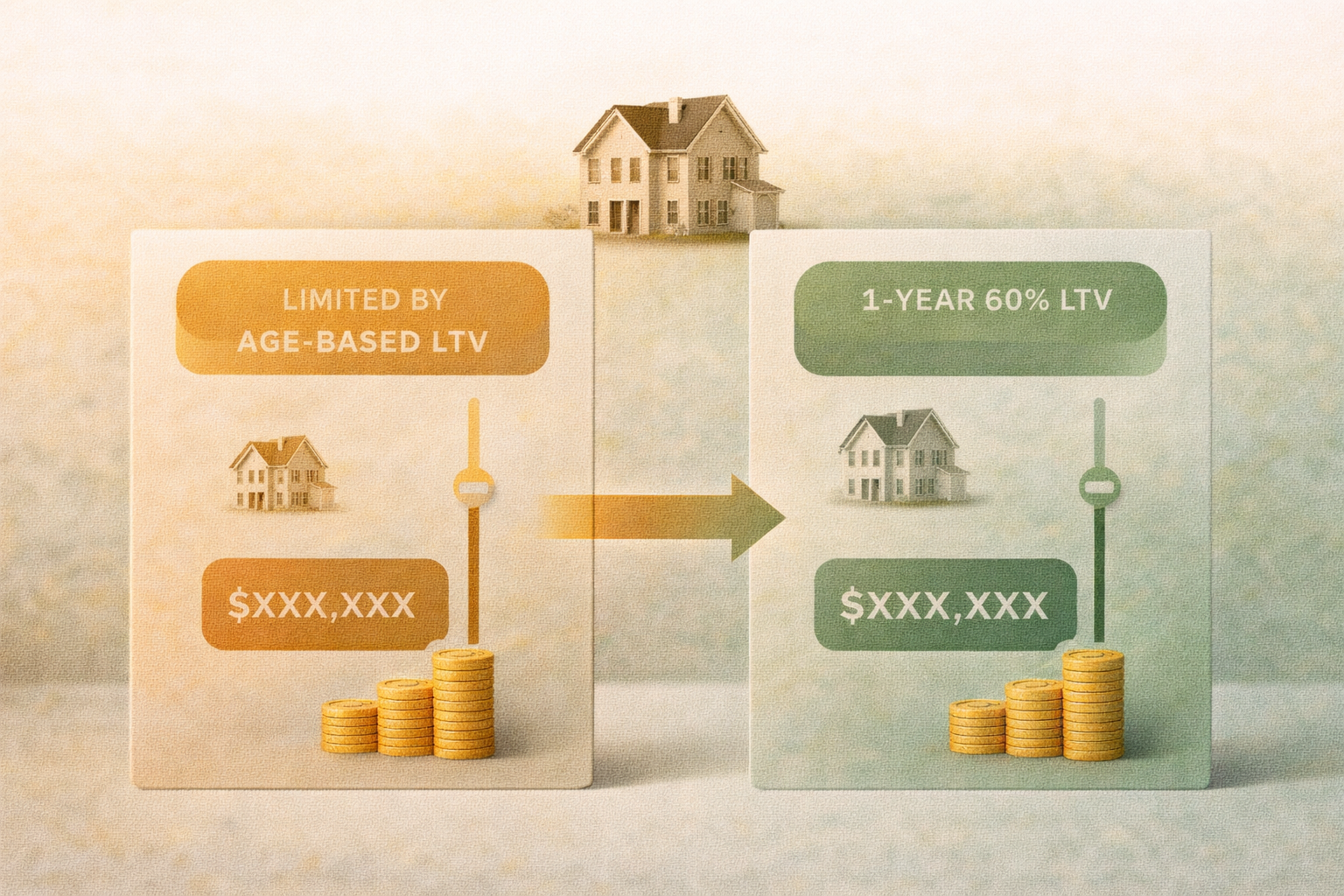
Reverse mortgage LTV: Age-dependent. Increases as the borrower gets older. For a 55-year-old borrower, typically in the range of 20-30% of the home's value. For a 75-year-old, closer to 40-50%. The exact figure depends on the lender, the property type, and the location.
Term mortgage LTV: Term-dependent. Independent of age.
1-year term: up to 60% LTV
3-year term: up to 49.5% LTV
4-year term: up to 46% LTV
5-year term: up to 43% LTV
The crossover point — where the term mortgage's LTV exceeds the reverse mortgage's LTV — depends on the borrower's age. For a 55-year-old, the term mortgage almost always provides more. For a 75-year-old on a 1-year term, it may still provide more. For an 80-year-old, the reverse mortgage may have caught up.
The specific numbers for any individual situation come from the calculator at canadareversemortgageguide.ca/reverse-mortgage-calculator
Situation 1 — You Are Under 55 and a Reverse Mortgage Is Not Available
This one is straightforward, but worth stating clearly because it is the most common.
If you are under 55, there is no reverse mortgage available to you. Period. The minimum age requirement is 55 for all four Canadian reverse mortgage lenders.
For a homeowner under 55 with a high-value property and a genuine need to access capital without monthly payments, the term mortgage is not the better option — it is the only option in this category.
The example: A 48-year-old homeowner in Toronto owns a property worth $1.4 million with no mortgage. They need $600,000 to fund a business acquisition. They cannot qualify for a conventional mortgage due to a recent career change, and they do not want to sell the property.
A reverse mortgage: not available. Under 55.
A no-payment term mortgage on a 1-year term at 60% LTV: up to $840,000 available. After the minimum $100,000 qualification threshold, the $600,000 needed is comfortably within range.
The term mortgage provides what the borrower needs. The reverse mortgage cannot. There is no comparison to make.
The tradeoffs: The full balance is due in one year. Renewal is not guaranteed. The loan is full recourse. An exit plan — a conventional refinance once the business generates income, or a sale of the property if needed — must be in place before signing.
Situation 2 — You Are 55+ With a High-Value Property and Need Maximum Capital
This situation involves borrowers who are reverse mortgage eligible but for whom the age-based LTV of the reverse mortgage produces a loan amount that does not meet the need — while the term mortgage's higher LTV on a shorter term does.
The example: A 58-year-old homeowner in Vancouver owns a property worth $2.2 million with no mortgage. They need $900,000 to fund a major renovation that will significantly increase the home's value, plus provide a reserve for other purposes.
A reverse mortgage for a 58-year-old: approximately 25-30% LTV depending on the lender and property type. On a $2.2 million home, that is approximately $550,000 to $660,000. The $900,000 needed is not reachable through a reverse mortgage alone.
A no-payment term mortgage on a 1-year term at 60% LTV: up to $1,320,000 available. The $900,000 needed is comfortably within range.
The term mortgage provides what the reverse mortgage cannot.
The tradeoffs: The full balance is due in one year. At $900,000 borrowed at current rates over 12 months with no payments, the interest building on the balance is meaningful. The renovation must be completed and the exit plan must be credible — a conventional refinance once the renovation is complete and the property value reflects the improvement, or a sale. This is a sophisticated use of the product. It requires careful planning and a broker who understands both products.
Situation 3 — You Are 55+ and Need Short-Term Capital With a Clear Exit
This situation is about timing, not size. The borrower is reverse mortgage eligible, the reverse mortgage LTV may even be sufficient — but the nature of the need is short-term, with a specific exit event on the horizon, making the term mortgage the cleaner fit.
The example: A 62-year-old homeowner in Ottawa is selling their current home and buying another. The purchase closes two weeks before the sale. They need $350,000 for 45 days to bridge the gap — funds that will be fully repaid from the sale proceeds.
A reverse mortgage: technically available. But a reverse mortgage is structured as a long-horizon product. The setup costs, legal fees, and application process are designed for a mortgage that will be in place for years. Using a reverse mortgage as a 45-day bridge, then discharging it when the sale closes, is using the wrong tool for the purpose.
A no-payment term mortgage on a 1-year term: structured exactly for short-term capital needs. No exit penalties. The balance is repaid from the sale proceeds when the existing home closes. Clean and simple.
A second example: A 65-year-old homeowner is waiting for a significant inheritance that will arrive in approximately 18 months. In the interim, they need $200,000 to manage a transition. The reverse mortgage is available, but the borrower does not want a long-term mortgage — they want a bridge that terminates cleanly when the inheritance arrives.
The 1-year term mortgage (potentially renewable for a second term) provides the bridge. The inheritance repays the balance. The reverse mortgage would have been a longer commitment than the situation requires.
The tradeoffs: In both cases, the tradeoff is renewal risk. The bridge must land — the sale must close, the inheritance must arrive — or the exit plan is compromised. If the timing slips, the borrower needs either a renewal or a new plan. That risk is real and must be honestly assessed before signing.
When the Reverse Mortgage Wins Instead
Honesty requires naming the other side of the comparison.
For the large majority of homeowners 55 and older who are not in one of these three specific situations — who want long-term tenure certainty, who value the no negative equity guarantee, who do not have a specific exit event in view, who plan to stay in their home for many years — the reverse mortgage is the better product.
The reverse mortgage does not expire. It does not require a repayment event. It renews automatically. The no negative equity guarantee protects the estate. It does not require an exit plan because staying in the home is the plan.
The term mortgage wins on LTV and flexibility in specific, time-limited situations. The reverse mortgage wins on structure, protection, and long-term certainty in the general case.
The Honest Summary
The no-payment term mortgage gives you more than a reverse mortgage in three situations:
1. You are under 55 — the reverse mortgage is not available, the term mortgage is the only no-payment option.
2. You are 55+ with a high-value property and need maximum capital — the term mortgage's LTV exceeds what the reverse mortgage can provide at your age.
3. You are 55+ with a specific short-term capital need and a clear exit event — the term mortgage is the cleaner, more appropriate tool for a defined bridge period.
In all three cases, the term mortgage's advantages come with real tradeoffs — fixed term, renewal risk, no no-negative equity guarantee, mandatory exit plan. Those tradeoffs must be understood and accepted before signing.
The calculator at canadareversemortgageguide.ca/reverse-mortgage-calculator shows what both products would offer for your specific age, property value, and location. Use it as the starting point. Then have the conversation with a broker who works with both.
[Get Your Free Comparison at Canada Reverse Mortgage Guide →]
This article is for educational purposes only and does not constitute financial, tax, investment, or mortgage advice. LTV ratios, rates, and product availability are subject to change. Renewal of the no-payment term mortgage is not guaranteed. All figures used in examples are illustrative only. A licensed Canadian mortgage broker can provide current product details and model both options for your specific situation.