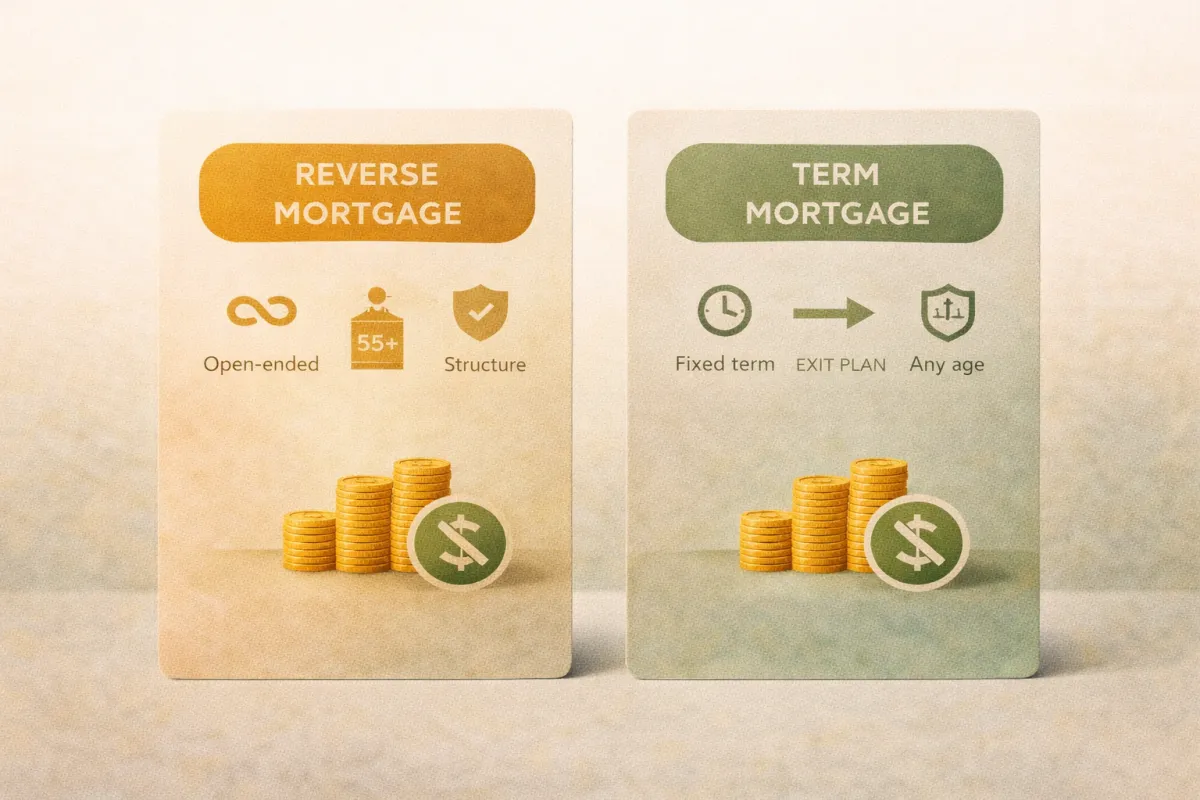
How Does a Term Mortgage Differ From a Reverse Mortgage? A Plain-English Comparison
Both products let you access the equity in your home without making monthly payments.
That is where the similarity ends.
Beyond that shared feature, a reverse mortgage and a no-payment term mortgage are structurally different products with different risk profiles, different consumer protections, different eligibility requirements, and different situations they are suited for.
Understanding the difference is not complicated — but it matters enormously for anyone trying to decide which one fits their situation, or whether either of them does.
This post is the complete comparison.
The Shared Feature — And Why It Matters
Both products suspend the monthly payment obligation. That is the feature that makes them unusual in the Canadian mortgage market and the feature that draws people to both of them.
For a borrower whose primary problem is cash flow — a mandatory payment that the current income cannot comfortably support — both products address that problem. The interest builds on the outstanding balance rather than being paid monthly. The account is not being debited every month.
That shared feature is meaningful. But it is also where the similarity ends, and understanding what comes after it is what separates a well-informed decision from one made on a surface comparison.
The Complete Comparison
Age Eligibility
Reverse mortgage: Minimum age 55 for all borrowers on the application. If applying as a couple, both must be 55+.
No-payment term mortgage: No minimum age restriction. Available to homeowners of any age who meet the property and qualification requirements.
This is the most fundamental difference for many borrowers. The reverse mortgage is simply not available to someone under 55. The term mortgage is. For a 45-year-old homeowner with significant equity and a genuine need, the term mortgage is the only no-payment option.
Term Structure
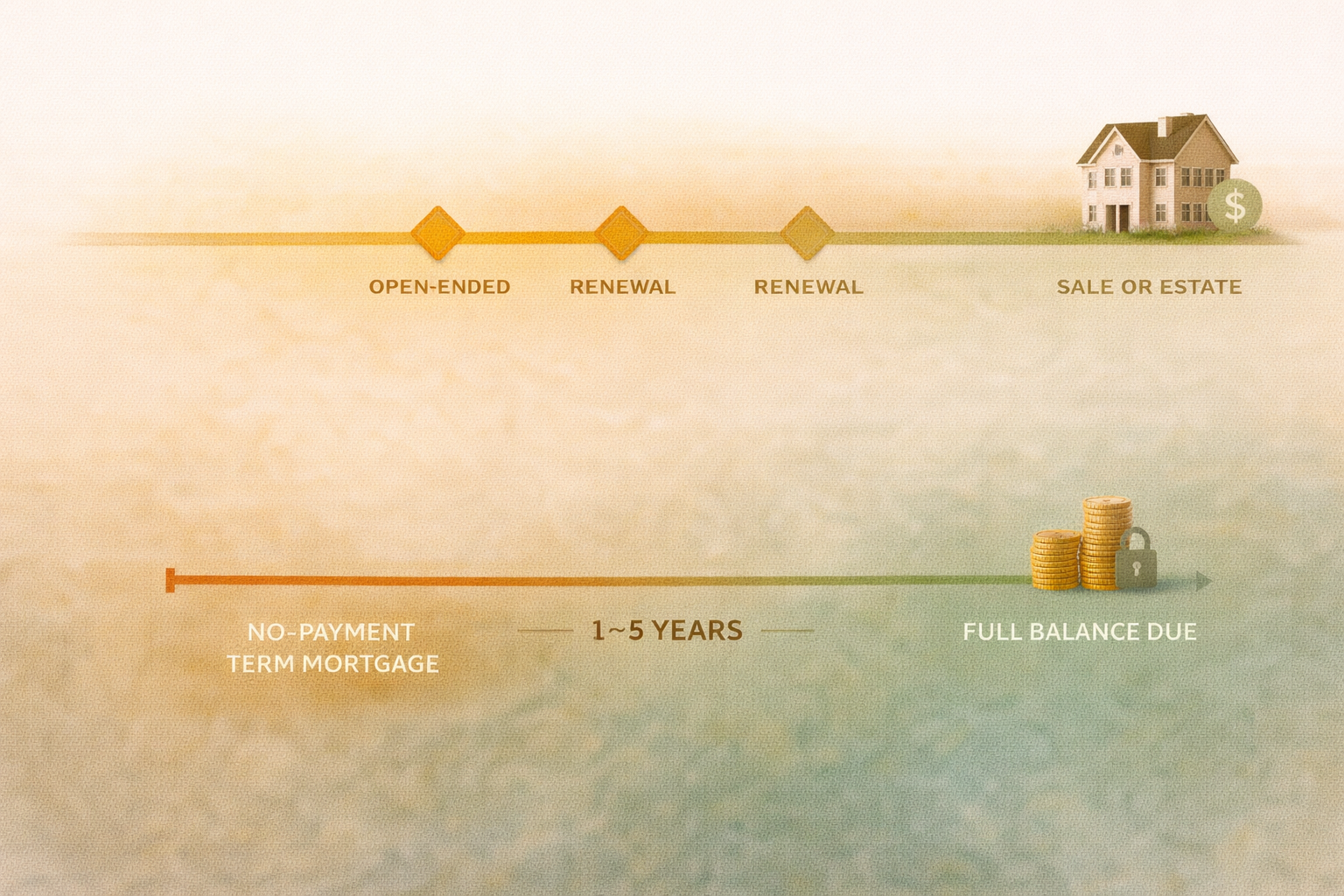
Reverse mortgage: Open-ended. The mortgage remains in place for as long as the borrower occupies the home as their primary residence, pays property taxes, and maintains insurance. It renews at the end of each term — typically every 1 to 5 years — without requiring repayment. There is no fixed end date.
No-payment term mortgage: Fixed term — 1, 3, 4, or 5 years. At the end of the term, the full balance is due. There is no open-ended structure. The loan has a hard stop.
This difference has significant practical implications. The reverse mortgage can be held for decades without forced repayment. The term mortgage requires a repayment event — or a renewal, which is not guaranteed — at a defined date in the future.
Renewal
Reverse mortgage: Renews automatically at term end, subject to the borrower continuing to meet the basic conditions of the mortgage. The renewal rate structure varies by lender — one lender renews above market rate, others at market rate, one product locks the rate for life.
No-payment term mortgage: Renewal is not guaranteed. At term end, the lender conducts a full file review. The loan may be renewed, declined, or offered at different terms. A borrower who has no plan for repayment other than renewal is in a precarious position.
This is arguably the most consequential structural difference. The reverse mortgage provides long-term certainty of tenure. The term mortgage does not.
Maximum LTV
Reverse mortgage: Depends on age — older borrowers qualify for higher LTV. Ranges roughly from low-20s percentage for younger eligible borrowers to just above 50% for older borrowers, depending on lender, property type, and location.
No-payment term mortgage: Depends on term length — shorter terms have higher LTV. 1-year term: up to 60%. 3-year term: up to 49.5%. 4-year term: up to 46%. 5-year term: up to 43%. These apply regardless of the borrower's age.
For a 55-year-old borrower, the term mortgage on a 1-year term at 60% LTV may offer more than any reverse mortgage product. For a 75-year-old borrower, the reverse mortgage LTV advantage grows with age. The right product depends on the specific age and the specific LTV requirement.
Consumer Protections — No Negative Equity Guarantee
Reverse mortgage: All four Canadian reverse mortgage lenders offer the no negative equity guarantee. If the home sells for less than the outstanding balance, the lender absorbs the loss. The borrower's other assets — savings, investments, other property — are not at risk. This protection applies to the estate as well as the borrower.
No-payment term mortgage: No negative equity guarantee. It is a full recourse loan. If the sale proceeds do not cover the outstanding balance, the lender can pursue the borrower's other assets. The estate is also exposed.
This is the most significant consumer protection difference between the two products. For a borrower who is concerned about the estate outcome — or who has meaningful other assets they want to protect — the no negative equity guarantee is a substantial advantage of the reverse mortgage.
Exit Plan Requirement
Reverse mortgage: No formal exit plan required. The open-ended structure means the borrower can remain in the home indefinitely without a repayment event.
No-payment term mortgage: A solid exit plan is required before funding. The lender and broker will ask: if this loan is not renewed at term end, how will the balance be repaid? The exit plan must be specific, realistic, and credible — selling the property, refinancing with a conventional lender, a documented income event.
A borrower who cannot articulate a clear exit plan should not take this product. The exit plan is not a formality — it is the structural foundation of the transaction.
Interest Rate Structure
Reverse mortgage: Fixed rate for the term, compounding semi-annually as required by the federal Interest Act.
No-payment term mortgage: Variable rate, based on CORRA Swaps rather than prime rate. The rate moves with market swap rates. Because no payments are made during the term, the interest compounds on the outstanding balance throughout.
The variable rate introduces rate risk that a fixed reverse mortgage does not carry within the term. Over a 5-year term with no payments, a rate increase of 1% on a $300,000 balance adds approximately $15,000 in additional interest building on the balance over the term. This is worth modelling before signing.
Geographic Availability
Reverse mortgage: Available across Canada, subject to property eligibility by lender.
No-payment term mortgage: Currently available on freehold residential properties in Ontario, Alberta, and British Columbia only.
Broker Fee Structure
Reverse mortgage: Lender pays the full broker fee. Typically no broker fee to the borrower.
No-payment term mortgage: Lender pays 50% of the standard reverse mortgage broker fee. A broker fee may apply depending on the complexity of the file. Always disclosed in writing before any commitment.
The Decision Framework
Given all of the above, here is a plain-English framework for deciding which product — if either — fits a given situation:
Use a reverse mortgage if:
You are 55 or older
You want long-term certainty of tenure — you plan to stay in the home indefinitely
The no negative equity guarantee matters to you or your estate
You are not comfortable with a fixed repayment date
You want the rate locked for the term or for life
Use a no-payment term mortgage if:
You are under 55 and the reverse mortgage is not available
You are 55+ but the LTV available from a term mortgage exceeds what any reverse mortgage product offers for your situation
You have a specific, time-limited financial need with a clear exit plan
You are comfortable with the renewal risk and have a plan if renewal is declined
The product is available in your province
Use neither if:
Your income comfortably services a conventional mortgage or HELOC
You do not have a genuine financial need that the no-payment structure addresses
You do not have a clear plan for the term mortgage's repayment at term end
The Plain-English Summary
Both products remove the monthly payment obligation. That is where the similarity ends.
The reverse mortgage is a long-horizon, open-ended product with strong consumer protections and no forced repayment event. It is for homeowners 55+ who want to stay in their home.
The no-payment term mortgage is a fixed-term product with a hard repayment date, no age restriction, potentially higher LTV, and no no-negative equity guarantee. It requires a genuine exit plan. It is for borrowers of any age who have a specific, time-limited need and a credible plan for repayment.
The right product depends on the specific situation. Use the calculator at canadareversemortgageguide.ca/reverse-mortgage-calculator to see what each would offer for your property and age. Then have the conversation with a broker who works with both.
[Get Your Free Comparison at Canada Reverse Mortgage Guide →]
This article is for educational purposes only and does not constitute financial, tax, investment, or mortgage advice. Product terms, LTV ratios, rates, and availability are subject to change. Renewal of the no-payment term mortgage is not guaranteed. A licensed Canadian mortgage broker can provide current product details and assess suitability for your specific situation.