
Under 55 and Need to Access Your Home Equity? There's an Option Most People Don't Know Exists
The reverse mortgage conversation in Canada has an age problem.
Not a problem with the product — with the awareness. Every discussion of no-payment home equity access in Canada defaults to the reverse mortgage. Which is correct for homeowners 55 and older. But it leaves an entire demographic — homeowners under 55 who have significant equity and a genuine need to access it — with no obvious path.
The conventional options for under-55 homeowners are a HELOC, a conventional refinance, or a second mortgage. All of them require income qualification. All of them require monthly payments. For someone who is self-employed with variable income, recently between jobs, carrying other debt, or simply in a period of financial transition, these options may not be available — or not at an amount that actually addresses the need.
There is a fourth option that almost no one in this demographic knows about.
What the Product Is
Lender F — a Canadian mortgage company operating in Ontario, Alberta, and British Columbia — offers a no-payment term mortgage on residential freehold properties. It is not a reverse mortgage. It does not carry the same consumer protections. But it shares the most important functional feature: no mandatory monthly payment.
The structure is a fixed-term mortgage — available in 1, 3, 4, or 5 year terms — with no monthly payment required during the term. The full balance is due at the end of the term. Interest builds on the outstanding amount throughout. The loan is in first position on the property.
There are no exit penalties. The loan can be repaid at any time during the term without penalty — which is a genuinely unusual feature in Canadian mortgage products.
Key product parameters:
Minimum loan: $100,000. Available on freehold residential properties in Ontario, Alberta, and British Columbia only. No age restriction — available to homeowners of any age.
The rate is variable, based on CORRA Swaps rather than prime rate.
Who This Is For
The no-payment term mortgage is most useful for homeowners who have meaningful equity, a specific financial need, and a clear plan for how the loan will be repaid at the end of the term.
Some of the situations where it fits:
Bridge financing during a transition. Self-employed homeowners whose income is temporarily reduced, employees between jobs, business owners managing a difficult period — anyone who has equity but whose current income does not support conventional mortgage qualification. The no-payment structure removes the immediate cash flow pressure while the transition resolves.
Debt consolidation without payment pressure. High-interest consumer debt — credit cards, personal loans, car financing — can be consolidated into the term mortgage at a significantly lower rate, without the mandatory payment of a conventional refinance. The interest savings are immediate. The repayment is deferred to the end of the term.
Access to capital for a specific purpose. A business investment, a real estate transaction, a family need — situations where access to a significant amount of capital is needed for a defined period and the borrower has a clear plan for generating the funds to repay at term end.
High-value properties where the LTV advantage matters. For homeowners with properties worth $1.5 million or more, the LTV available through a no-payment term mortgage — up to 60% on a one-year term — can be significantly higher in dollar terms than what a reverse mortgage would provide at the same age. For a 55+ homeowner with a high-value property, Lender F may offer more than a reverse mortgage even if both options are available.
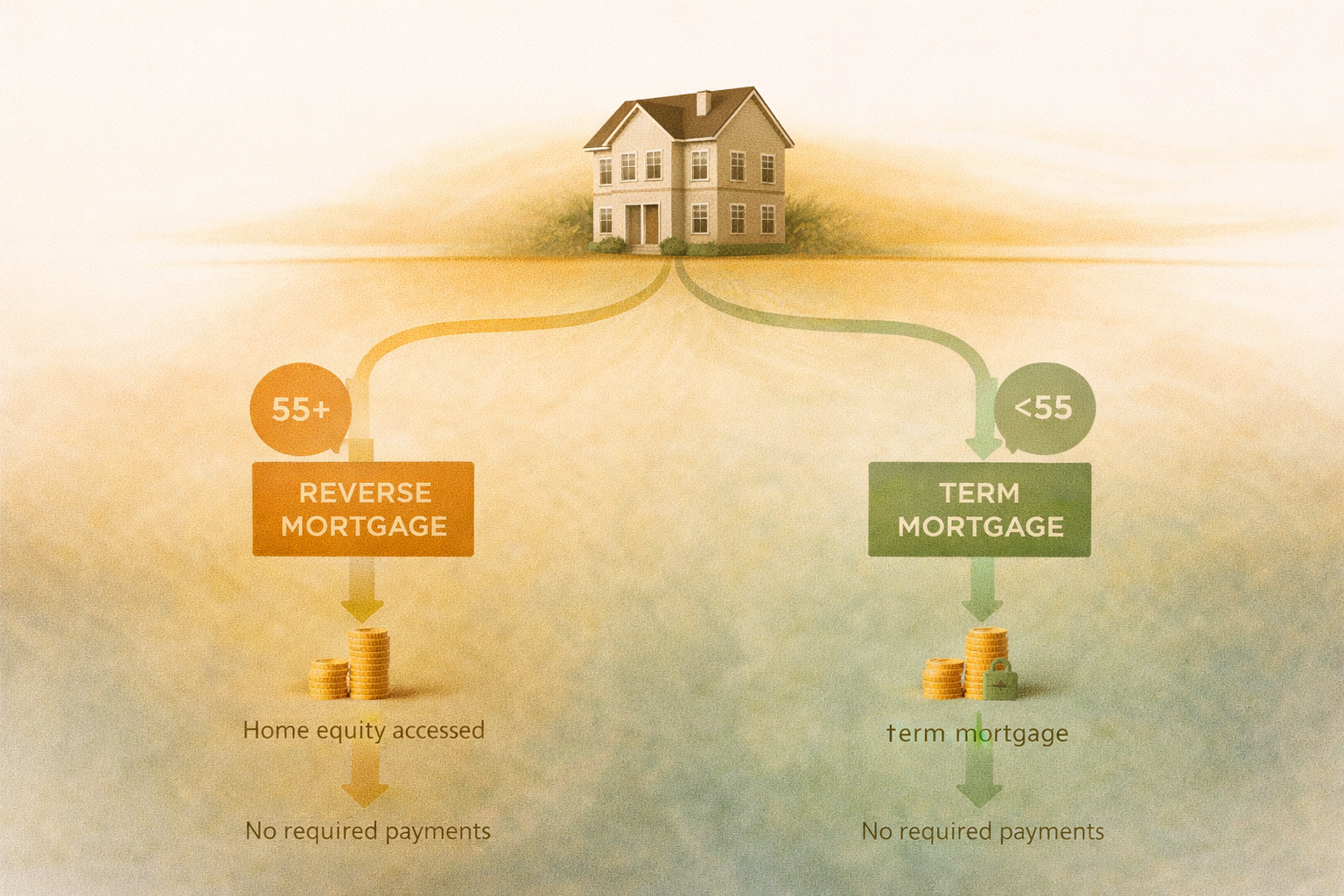
What Is Different From a Reverse Mortgage
This is the section that matters most if you are comparing the two products.
Age restriction. Reverse mortgages require age 55+. The no-payment term mortgage has no age restriction.
Term structure. A reverse mortgage is open-ended — it stays in place until the borrower sells, moves permanently, or passes away. The no-payment term mortgage has a fixed term — 1, 3, 4, or 5 years — at the end of which the full balance is due.
Renewal. A reverse mortgage renews automatically (subject to conditions). Renewal of the no-payment term mortgage is not guaranteed. A full file review is conducted at term end. There is no guarantee the loan will be renewed or that the next term's terms will be the same.
Consumer protections. Reverse mortgages carry the no negative equity guarantee — the estate will never owe more than the home is worth. The no-payment term mortgage does not carry this protection. It is a full recourse loan — the lender can pursue other assets if the sale proceeds do not cover the outstanding balance.
Exit plan requirement. Because renewal is not guaranteed, a solid exit plan is required before funding. The exit plan is the answer to: if this loan is not renewed at term end, how will the balance be repaid? Selling the property, refinancing with another lender, or a significant income event are all legitimate exit plans. A vague intention to "figure it out later" is not.
The Exit Plan — Why It Cannot Be an Afterthought
The most important concept for a borrower considering this product is the exit plan. It is not a formality. It is the structural foundation of the entire transaction.
A no-payment term mortgage that works well looks like this: a borrower with a clear purpose for the funds, a realistic timeline for their situation to resolve, and a specific plan for repaying the balance at term end — whether through a conventional refinance when income normalises, a sale of the property, or another identified source of funds.
A no-payment term mortgage that creates problems looks like this: a borrower who used the no-payment feature to avoid thinking about repayment, whose situation at term end is not materially better than when they started, and who is now facing a full balance due with no clear path to pay it.
The lender will ask about the exit plan. The broker should ask about the exit plan. And the borrower should have thought it through carefully — not as a checkbox, but as a genuine plan — before signing.
Post 29 of this series covers exit strategies in detail.
A Note on the Broker Fee
Because this product is structured differently from a reverse mortgage, the lender fee and broker compensation structure are different. Lender F pays 50% of the standard reverse mortgage broker fee. Depending on the complexity of the file, a broker fee may apply — this will always be disclosed in writing before any commitment is made.
Ask your broker directly: what fees will I pay on this transaction, and how are you being compensated? A transparent answer is the only acceptable one.
The Plain-English Summary
If you are under 55, own a freehold home in Ontario, Alberta, or British Columbia, have at least $100,000 in equity, and need to access a meaningful amount of capital without making monthly payments — the no-payment term mortgage from Lender F is worth understanding.
It is not a reverse mortgage. It does not carry the same consumer protections. It requires a genuine exit plan. The broker fee structure is different. Renewal is not guaranteed.
But for the right borrower in the right situation — with a clear purpose, a realistic timeline, and a solid exit plan — it is a genuinely useful tool that almost no one in this demographic knows exists.
Use the calculator at canadareversemortgageguide.ca/reverse-mortgage-calculator to see what would be available for your property. Then have the conversation.
[Get Your Free Comparison at Canada Reverse Mortgage Guide →]
This article is for educational purposes only and does not constitute financial, tax, investment, or mortgage advice. The no-payment term mortgage described is subject to lender approval, property eligibility, and individual qualification. LTV ratios, rates, and terms are subject to change. Renewal is not guaranteed. A licensed Canadian mortgage broker can provide current product details and assess suitability for your specific situation.