
Grey Divorce — You Kept the House. Now What?
This is Part 1 of a two-part series on grey divorce and home equity. This post covers the situation of keeping the house after a divorce settlement — the financial reality, the options, and why a reverse mortgage may be the tool that makes it possible. Part 2 covers the equity buyout itself — how one spouse can pay out the other without either of them having to sell.
Grey divorce — the term for marriages that end after 50 — is one of the fastest-growing demographic trends in Canada. While overall divorce rates have been relatively stable, divorces among Canadians over 55 have risen steadily for two decades. The reasons are as varied as the people involved. Grown children. Grown apart. Decades of quiet incompatibility finally acknowledged. A second chapter that one person wants and the other doesn't.
Whatever the reason, the financial aftermath follows a fairly predictable pattern.
One person keeps the house. The other gets their share of the equity — in cash, in other assets, in a buyout arrangement. And the person who keeps the house is left with something they very much want to hold onto, and a financial picture that has just become significantly more complicated.
This post is about what happens next for the person who kept the house.
The Problem With Keeping the House at 60
Let's be direct about what makes this situation difficult.
Before the divorce, there were two incomes, two CPP entitlements, possibly two pensions, and a mortgage — if there still was one — being serviced by a household with two earners. The numbers worked.
After the divorce, there is one income. One CPP. One OAS. No pension, or half a pension, or a pension that is smaller than expected because career interruptions or caregiving years reduced it. The mortgage — if the house wasn't fully paid off — now needs to be serviced or refinanced on a single income.
And here is where things get stuck.
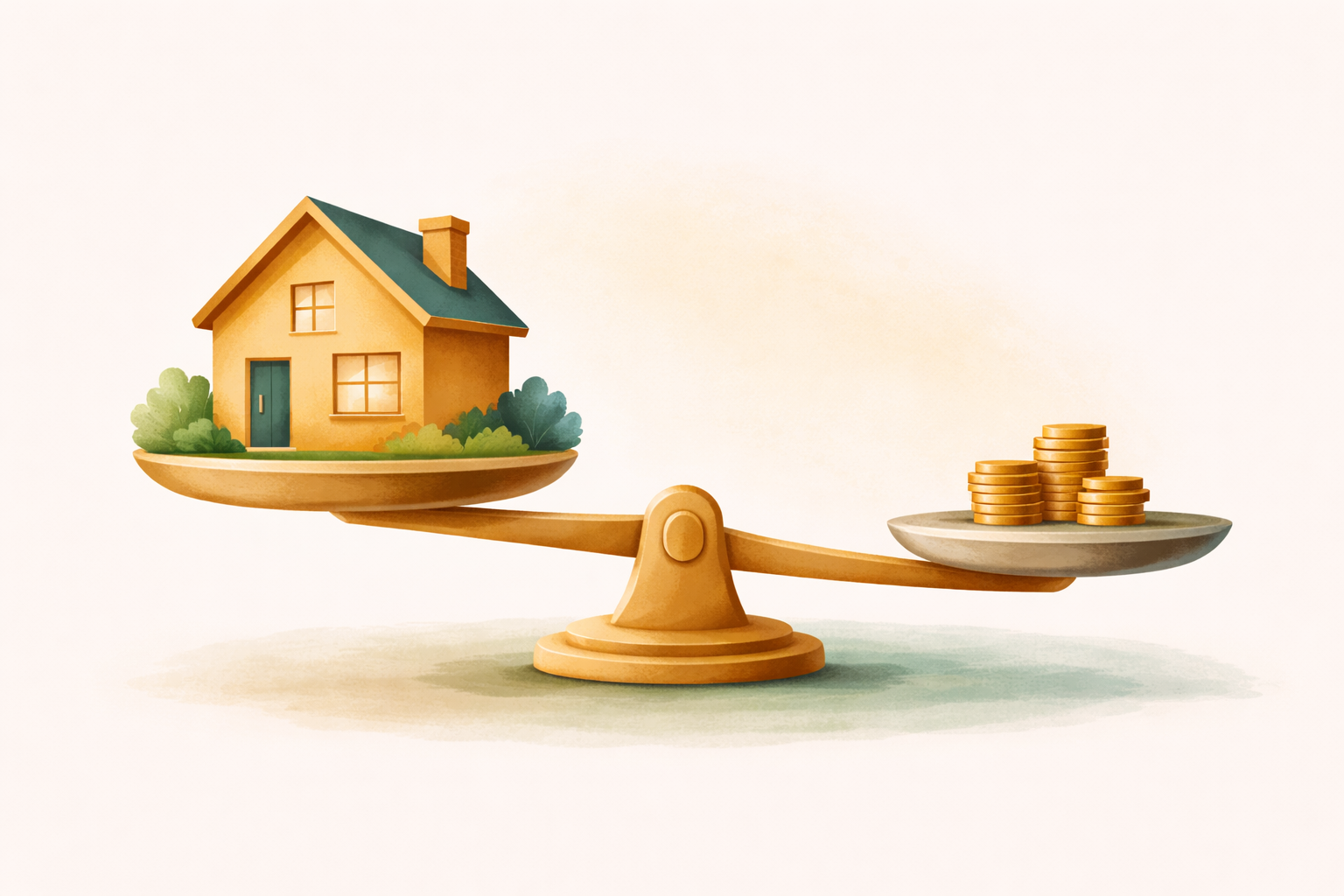
To qualify for a conventional mortgage in Canada, a lender looks at your income. Not your net worth. Not the equity in your house. Your income. And the income of a recently divorced woman or man in their late 50s or 60s — particularly one who took time away from the workforce for family reasons — often does not qualify for a mortgage large enough to manage what they need to manage.
The equity is real. The house is worth what it is worth. But the banks are looking at income, and the income isn't there.
This is the equity-rich, income-poor trap. It is one of the most common financial situations among grey divorcees who kept the family home, and it is almost completely absent from mainstream financial planning conversations.
What Needs to Be Managed
Depending on the specifics of the divorce settlement, the person who kept the house may be facing one or more of the following:
A buyout obligation. If the home was jointly owned and the other spouse accepted a deferred buyout — meaning they agreed to receive their share of the equity at some future point — there may be a financial obligation coming due. Managing that obligation without being forced to sell requires access to the equity in the home.
An existing mortgage. If the home was not fully paid off, the remaining mortgage may need to be refinanced in one name. Qualifying for that refinance on a single retirement income is often where the problem begins.
A cash flow gap. Even if the house is fully paid off and there is no buyout obligation, the transition from a two-income household to one changes the monthly math. The living costs of the house — property taxes, insurance, maintenance, utilities — were designed for two incomes. Now they are being carried by one.
Depleted savings. Divorce is expensive. Legal fees, the settlement itself, the cost of establishing a single household — all of it draws down savings that were meant for retirement. Many people emerge from a grey divorce significantly less liquid than they expected to be.
In all of these situations, the equity in the house is the largest financial resource available. The question is how to access it.
The Options — And Why Most of Them Don't Work

Sell the house. For some people, this is the right answer. If the house is too large, too expensive to maintain, or too tied to a life that no longer exists, selling and downsizing makes practical and emotional sense. But for many people — particularly those who have lived in the same home for decades, whose social networks and communities are rooted in the neighbourhood, who genuinely want to stay — being told to sell feels like the divorce taking a second thing from them. It is a legitimate option. It is not the only one.
Conventional refinance or HELOC. This is where most people start, and where most people hit a wall. A HELOC or conventional refinance requires income qualification. Lenders want to see that you can service the debt from your income. For a retiree or near-retiree on CPP and OAS alone — particularly one whose career was interrupted — that qualification often doesn't work. The equity is there. The income isn't.
Borrowing from family. Sometimes this works. Often it creates a different kind of problem — one that strains relationships and introduces complexity that lasts for years.
A reverse mortgage. This is the option that most people in this situation have not considered — not because it doesn't apply, but because nobody told them about it.
Why a Reverse Mortgage Works Here
A reverse mortgage does not require income qualification. It does not require proof that you can make monthly payments — because there are no mandatory monthly payments. It is based on your age, the value of your property, and where you live.
For someone who is 55 or older, owns their home, and lives in it as their primary residence, a reverse mortgage lets them access a portion of the equity as tax-free cash — without selling, without qualifying on income, and without making monthly payments.
In the grey divorce context, this solves several problems at once:
If there is a buyout obligation: The reverse mortgage proceeds can fund the buyout, giving the other spouse their share of the equity and allowing the borrower to stay in the home — without income qualification and without forced sale.
If there is a cash flow gap: The reverse mortgage can provide a monthly draw that supplements CPP and OAS, covering the costs of a home that was built for two. Not as income — as loan proceeds that don't appear on a tax return and don't affect government benefits.
If savings were depleted by the divorce: A lump sum draw from the reverse mortgage can rebuild a financial cushion without the interest cost and income requirement of a conventional loan.
If there is an existing mortgage: In most cases, the reverse mortgage proceeds pay out the existing mortgage first. The mandatory payments disappear. The equity stays in the home. The cash flow improves immediately.
The interest builds on the reverse mortgage balance over time — it is not free money, and it is important to understand that the balance grows. But the alternative — selling a home you want to keep, or qualifying for a conventional mortgage you can't get — has its own costs. The question is which set of tradeoffs fits your situation.
The Option Nobody Mentions — Downsize and Use a Reverse Mortgage on the New Home
Most people think of a reverse mortgage as a tool for staying in their current home. It is that. But it is also something else that almost nobody talks about in the context of grey divorce: a way to downsize intelligently and actually come out ahead.
Here is how the conventional downsize math usually works.
You sell a $1,000,000 home. After the divorce settlement, you split the proceeds — let's say you receive $500,000. You use that $500,000 to buy a smaller home outright. You have a home and no mortgage. But you also have no savings. Every dollar went into the new property.
You have traded one illiquid asset for a smaller illiquid asset, and your cash position is exactly what it was before: zero.
Now here is what the math looks like if you bring a reverse mortgage into the picture.
You receive the same $500,000 from the sale. You buy a $500,000 home. But instead of paying cash outright, you use a reverse mortgage to fund a portion of the purchase price — the exact amount depends on your age, the property, and your location — and pay the remainder from your proceeds.
The result: you own a home with no mandatory mortgage payments, and you have meaningful savings that you did not have before. That capital can be invested, held as a cushion, used to supplement income, or simply kept as security against the unexpected.
How much can the reverse mortgage cover on a $500,000 purchase? At age 65, the approved amount will be less than half the property value — the exact figure depends on your specific profile. The reverse mortgage calculator will give you a realistic approval range based on your age, property value, and location. Use it before you run any numbers in your head.
Yes, the reverse mortgage balance will build interest over time. And yes, a $500,000 home gains less in absolute dollar terms than a $1,000,000 home — if both gain 5% in a year, the larger home adds $50,000 in value while the smaller one adds $25,000. That is a real tradeoff and worth understanding clearly.
But compare that to the alternative: no savings, no flexibility, and every financial emergency answered by drawing on a home you own outright but can't easily access.
For a grey divorcee who wants to right-size their life, reduce the maintenance burden of a large home, and emerge with actual liquidity — not just equity — the combination of a strategic downsize and a reverse mortgage on the new property is one of the most underused tools available.
All Canadian reverse mortgage lenders allow the product to be used on a purchase. But there is a critical sequencing point that cannot be skipped: the lender must accept the property before you sign a purchase contract. The home is the primary security for the loan. If the lender declines the property — because of its type, condition, or location — after you have already committed to the purchase, you are in a very difficult position. A condition on financing must be included in any purchase offer. Do not waive it. A broker who understands reverse mortgage purchases will know exactly how to structure this correctly from the start.
The Emotional Reality Nobody Puts in the Brochure
Keeping the house after a grey divorce is rarely a purely financial decision.
The house is continuity. It is the place the adult children come back to. It is the neighbourhood where people know your name. It is the garden you planted. It is the room where you slept for thirty years and the kitchen where you have made ten thousand meals.
For many people, keeping the house is not just a preference — it is a form of stability in a period of profound change. It is the one thing that didn't have to change.
A reverse mortgage cannot fix the grief of a marriage ending. But it can remove the financial pressure that would otherwise force a decision — sell the house — that you are not ready to make and may never need to make.
That is not a small thing.
What You Need to Know Before You Start
If you are in this situation — recently divorced or in the process of divorcing, over 55, keeping the house, and wondering whether a reverse mortgage could help — here is what to know before you have the first conversation:
Age matters. The older you are, the more you can borrow as a percentage of your home's value. If you are 58, you will be approved for a smaller amount than if you are 65. Both may still be enough for your purposes, but knowing this helps set expectations.
The home needs to be your primary residence. You need to live in it. A reverse mortgage on a vacation property or investment property is not available.
The settlement matters. If the divorce is not yet final, or if there are legal encumbrances on the title, those need to be resolved before a reverse mortgage can be put in place. A broker who specialises in this situation will know how to work with your lawyer to sequence things correctly.
There are four lenders and six products. The terms — interest rates, how funds can be drawn, renewal rate structures, optional payment conditions — vary significantly. Working with a broker who knows all four lenders and compares them for your specific situation is not optional. It is how you avoid leaving money on the table or accepting worse terms than you needed to.
This is Part 1 of a two-part series. This post covers the situation of keeping the house. Part 2 covers the equity buyout — specifically, how to give your former spouse their share without selling, using home equity to fund the settlement itself. If that is your situation, read Part 2 next.
[Get Your Free Comparison at Canada Reverse Mortgage Guide →]
This is Part 1 of a two-part series. Read Part 2: How Do You Split a House Without Selling It? The Equity Buyout Most Divorcing Couples Never Consider
This article is for educational purposes only and does not constitute financial, tax, legal, or mortgage advice. Divorce settlements vary significantly by province and individual circumstance. Legal and financial advice specific to your situation should be sought from qualified professionals. All reverse mortgage products are subject to individual lender approval and terms.