
Why Waiting to Use Your Home Equity Could Cost You More Than Using It Now
"I'll think about it."
It is the most common response to a reverse mortgage conversation. And it is completely understandable. This is a significant financial decision involving the most valuable asset most Canadians own. Thinking carefully before acting is not a character flaw. It is good judgment.
But "I'll think about it" has a cost that most people do not account for. Not the cost of the reverse mortgage itself — the cost of the waiting. The unrealised benefits that are not accumulating. The problems that are not being addressed. The decisions that are being made by default rather than by design.
This post is about that cost. Not to pressure anyone into a decision they are not ready to make — but to make the cost of delay visible so that the decision, when it is made, is genuinely informed.
And because this is a post about honest financial thinking: it also covers the situations where waiting is the right answer.
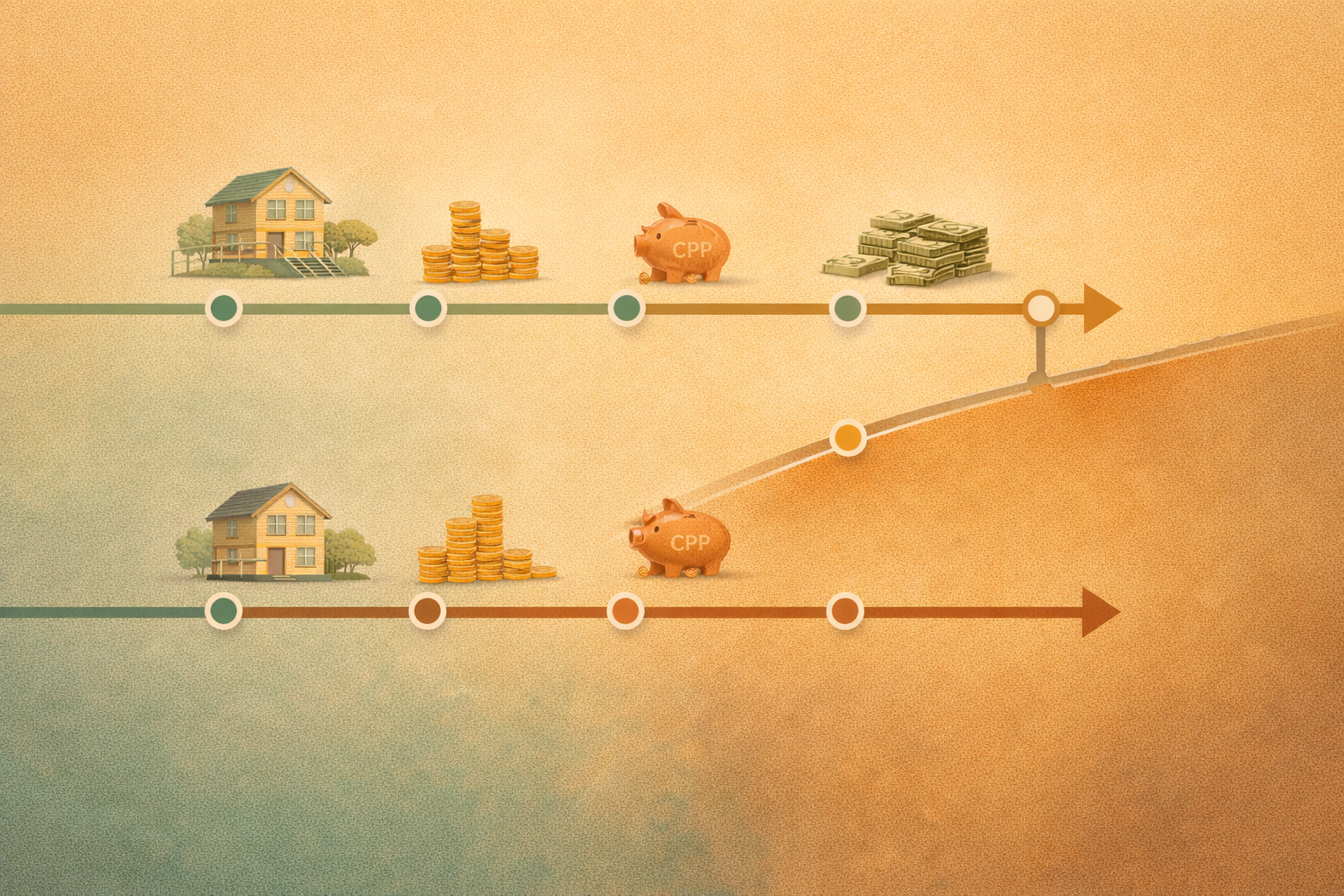
The Cost of Carrying Debt While You Wait
The most immediately quantifiable cost of delay is the one that applies to anyone carrying debt.
If you have a mortgage, a HELOC, a car loan, or credit card debt, that debt is costing you money every month. A $150,000 mortgage at current rates costs roughly $800 to $1,000 per month in payments. A $50,000 HELOC balance at prime plus 0.5% costs $200 to $300 per month in interest. A $20,000 credit card balance at 20% costs $333 per month in interest alone.
Every month you delay converting that debt into a reverse mortgage — where the mandatory payment disappears and the interest rate is typically lower than a HELOC or credit card — is a month of payments that did not need to be made.
Over 12 months of delay on a $150,000 mortgage at $900 per month, that is $10,800 in payments that left the account. Over 24 months, it is $21,600. That money is gone. It did not go toward building equity. It went toward servicing a debt that could have been restructured.
The reverse mortgage does not eliminate the debt. It converts it — from mandatory monthly payments into a balance that builds interest semi-annually with no required payment. The total debt on day one is essentially unchanged. The cash flow changes immediately and substantially.
For every month of delay, that cash flow improvement is not happening.
The Cost of Deferring the CPP Decision
For someone considering using home equity to bridge income while deferring CPP — a strategy explored in depth in Post 5 — every month of delay has a measurable cost.
CPP increases by 0.7% per month for every month past 65 that it is deferred, up to age 70. If you are 65 and drawing CPP today rather than deferring, you are locking in a payment that is 42% lower than what you would receive at 70.
The math is unforgiving. At a CPP benefit of $1,000 per month at 65, deferring to 70 would produce $1,420 per month — a difference of $420 per month, guaranteed, indexed to inflation, for life.
If you live to 85 — not an unusual expectation for a healthy 65-year-old Canadian — that difference accumulates to $63,000 in additional lifetime CPP income (in today's dollars, before inflation indexing). The break-even point on deferral is roughly your mid-70s. Every year of healthy life past that point is a year that deferral is paying off.
The barrier to deferral is almost always cash flow. You need income to live on while CPP grows. Without a plan to bridge that income gap, most people take CPP early — not because it is the better financial decision, but because it is the path of least resistance.
Home equity is the bridge. A reverse mortgage structured to supplement income during the deferral years allows CPP to grow without requiring the homeowner to draw down savings or sell investments.
Every year of delay in setting up that bridge is a year in which the CPP deferral decision may be made by default — not because it was the right choice, but because the alternative wasn't arranged.
The Cost of Deferred Modifications and Care
As discussed in Post 12, a health event can change the accessibility requirements of a home quickly and significantly.
A stair lift, a walk-in shower, grab bars, a ramp — these are not cosmetic upgrades. They are the difference between a home that is safe to live in and one that is not. When a fall happens or a surgery changes mobility requirements, the need for modifications can go from theoretical to urgent in a matter of days.
The cost of deferring those modifications is not always financial. Sometimes it is a second fall. A care facility admission that could have been avoided. A family crisis triggered by the gap between what a person needs and what their home provides.
Home equity can fund modifications proactively — before the crisis, when there is time to plan them well, get multiple quotes, and implement them thoughtfully. Waiting until the crisis arrives means making those decisions under pressure, often at higher cost, often in a compressed timeline that does not allow for good decision-making.
This is one of the clearest cases where the cost of delay is not just financial. It is physical and human.
The Cost of Living Below Your Means Unnecessarily
This one is harder to quantify but no less real.
Some homeowners are living more carefully than they need to — cutting back on travel they would enjoy, putting off a home improvement they want, not contributing to a grandchild's RESP because the cash is not there, declining social invitations because the discretionary budget is tight — when they are sitting on $400,000 or $600,000 or $800,000 of home equity.
The equity is real wealth. It was built over decades of mortgage payments, maintenance, and the decision to stay. It is not a mirage.
The assumption that it is off-limits — that it can only be accessed by selling — leaves many Canadians in a retirement that is financially more constrained than it needs to be. Not because they made bad financial decisions. Because nobody told them there was a different option.
Every year of unnecessary financial constraint is a year of retirement that did not need to be that way. That cost is real, even if it never shows up on a balance sheet.

When Waiting Is the Right Answer
This post would not be honest if it did not acknowledge the situations where waiting genuinely makes sense.
Your debt is small and almost paid off. If the mortgage has 18 months left and you can comfortably service it, finishing it may be simpler than restructuring. The break-even on a reverse mortgage's setup costs requires a meaningful benefit to justify them.
Your income is genuinely comfortable. If CPP, OAS, a pension, and investment income are covering your lifestyle with room to spare, there may be no problem to solve right now. A reverse mortgage should address a real gap. If the gap does not exist yet, it is reasonable to wait until it does.
Your home needs significant repairs before it would be accepted by a lender. A reverse mortgage lender will appraise the property and requires it to be in good condition. If the home needs substantial work first — a roof replacement, foundation issues, deferred maintenance — addressing those may need to happen before the application. In some cases, a reverse mortgage can fund those repairs as part of the process. A broker can advise on how to sequence this correctly.
You are still working and the income picture will change soon. If retirement is one or two years away and the financial picture will look significantly different when it arrives, waiting to see what that picture actually looks like before making decisions may be sensible. The reverse mortgage will still be available when you need it. The approved amount will likely be slightly higher with each passing year of age.
You need more time to understand the product. This is a legitimate reason. A decision this significant deserves to be understood before it is made. Reading this blog is part of that process. Speaking with a broker for a no-commitment conversation is part of it. Working with a financial advisor to model the scenarios is part of it. None of these require urgency.
The goal is not to rush anyone. The goal is to make sure the decision — whenever it is made — is made with a clear understanding of what waiting costs as well as what acting costs.
The Plain-English Summary
"I'll think about it" is not free. It has a cost — in debt payments that keep leaving the account, in CPP that starts earlier than it needed to, in modifications that get deferred until they become emergencies, in a retirement that is more constrained than the equity in the home would require it to be.
In some situations, waiting is the right answer. In many, it is not — it is simply the default, chosen not because it was evaluated and found to be best, but because the alternative was not fully understood.
Understanding what the alternative would actually look like — what you would be approved for, what it would cost, what it would solve — takes about an hour and costs nothing.
[Get Your Free Comparison at Canada Reverse Mortgage Guide →]
This article is for educational purposes only and does not constitute financial, tax, investment, or mortgage advice. CPP deferral benefits depend on individual contribution history, health, and life expectancy. Interest rates, mortgage costs, and lender terms vary. All figures used are illustrative only. A licensed Canadian mortgage broker working alongside a qualified financial advisor can help model these scenarios accurately for your specific situation. All reverse mortgage products are subject to individual lender approval and terms.