The Complete Retirement Financial Plan — How a Reverse Mortgage Fits With Your RRSP, TFSA, OAS, GIS, and CPP
Most retirement planning conversations start with a spreadsheet and end with anxiety.
You've got an RRSP that hasn't been touched since the market dropped. A TFSA that's half full, or half empty, depending on your mood. CPP coming in sometime between 60 and 70, depending on what your neighbour told you was smart. OAS lurking in the background, with a clawback threshold that nobody fully understands. Maybe a pension. Maybe not.
And then there's your house.
The house doesn't get a column in the spreadsheet. It's just... there. The biggest asset most Canadians own, sitting quietly in the background while everyone argues about whether you should draw down your RRIF before or after your OAS kicks in.
This post is about how all of it fits together — including the house.
Not as a last resort. Not as a sign that something went wrong. As a legitimate piece of retirement architecture, used intentionally alongside everything else you've already built.
Let's go through it one piece at a time.
First, a Word on How Retirement Income Actually Works in Canada
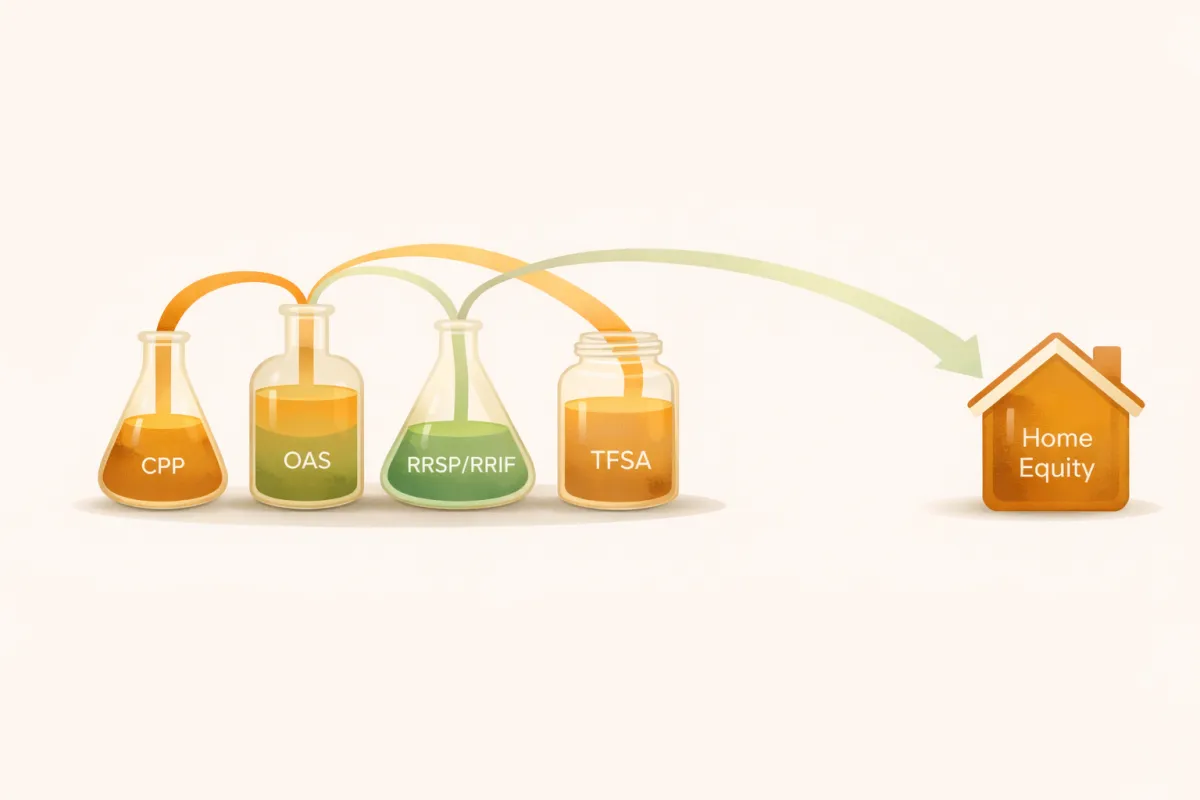
Most Canadians retire with income coming from a handful of different buckets:
Government benefits — CPP, OAS, and possibly GIS. These are the foundation. They're indexed to inflation (more or less), they're guaranteed by the federal government, and they generally represent a floor, not a ceiling.
Registered accounts — RRSP/RRIF and TFSA. The RRSP was built to defer tax during your working years; the RRIF is how you eventually draw it down. The TFSA, on the other hand, has no tax on withdrawal — what comes out doesn't count as income at all.
Non-registered investments — If you have them. Capital gains, dividends, interest. Taxable. Counted as income.
Pension — If you're lucky enough to have one. Defined benefit pensions are increasingly rare, but they exist. They count as taxable income.
Home equity — The asset that most Canadians have accumulated the most of, and the one that almost nobody has built into their financial plan.
The reason home equity gets ignored is simple: for most of your life, it's illiquid. To access it, you had to sell the house, take out a HELOC, or do a regular refinance — all of which require either moving or making monthly payments. Neither option appeals much to someone who just wants to stay in their home and stop working.
A reverse mortgage changes that equation. It lets you convert home equity into tax-free cash without selling, without making payments, and without leaving. Which is why, when you sit down to plan retirement income properly, it belongs in the conversation.
CPP — The Decision Everyone Gets Wrong
The Canada Pension Plan is one of the few sources of guaranteed, indexed lifetime income available to Canadians. You paid into it for decades. The question isn't whether to take it — it's when.
Your standard eligibility age is 65. But you can start as early as 60, or delay as late as 70.
Here's what the numbers look like:
Take CPP at 60: your benefit is reduced by 0.6% for every month before 65. That's a 36% permanent reduction.
Take CPP at 65: you receive your standard calculated amount.
Delay CPP to 70: your benefit increases by 0.7% for every month after 65. That's a 42% permanent increase.
The difference between taking CPP at 60 versus 70 can be substantial — sometimes $500 to $1,000 per month or more, depending on your contribution history, for the rest of your life.
The conventional wisdom says: if you're healthy, delay. The math generally supports this, with the break-even point on delaying to 70 (compared to 65) landing somewhere around your mid-70s — meaning that if you live past that point, delaying was the better financial choice. Most Canadians do.
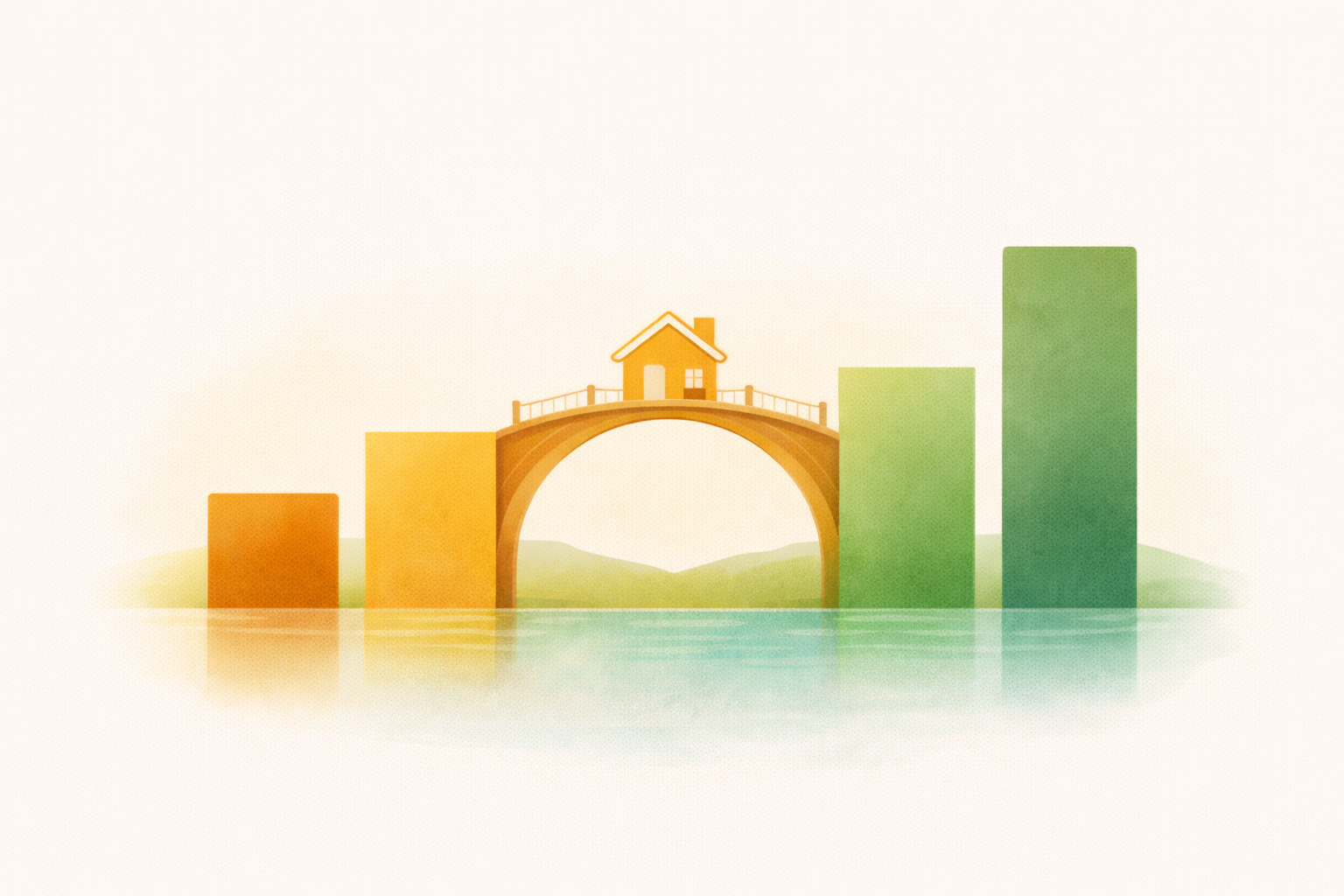
Where home equity comes in: The biggest practical barrier to delaying CPP is cash flow. If you stop working at 62 and you're not drawing CPP, what do you live on? For many Canadians, the answer has been to draw down their RRSP or their non-registered investments earlier than they'd like. That may not be optimal.
A reverse mortgage can bridge that gap. Draw on your home equity during the early retirement years — say, 60 to 65, or 65 to 70 — live on that, and let CPP grow in the background. When you eventually start CPP at a higher amount, you have a larger, guaranteed, indexed income stream for the rest of your life.
The home equity doesn't disappear. The interest builds on the reverse mortgage balance. But if the lifetime income gain from a higher CPP benefit exceeds the cost of the interest, the math can work out very much in your favour.
Every situation is different. This is exactly the kind of calculation worth doing with a financial advisor who understands both sides of the equation.
OAS — The Clawback Nobody Wants to Talk About
Old Age Security starts at 65 (or later, if you choose to defer). In 2025, the maximum monthly OAS payment is around $727 if you start at 65 — and it rises with deferral, similar to CPP, at 0.6% per month to a maximum increase of 36% if you wait until 70.
The part that trips people up is the OAS clawback — officially called the Old Age Security Recovery Tax.
In 2025, if your net income exceeds approximately $90,000, you begin to repay OAS at a rate of 15 cents for every dollar above that threshold. By the time your net income reaches around $148,000, your entire OAS benefit is clawed back.
This sounds like a problem for wealthy people. But it surprises many more Canadians than you'd expect — especially those with defined benefit pensions, RRIF income, investment income, and other sources all stacking on top of each other.
Where home equity comes in: Reverse mortgage proceeds are not income. The CRA does not treat the cash you receive from a reverse mortgage as taxable income — it's a loan. It doesn't show up on your tax return. It doesn't push you toward the clawback threshold.
This makes reverse mortgage draws a uniquely useful tool for retirees who are managing income levels carefully. Instead of triggering RRIF withdrawals in a year when your income is already high, you can draw on your home equity — income-neutral — and let the registered account sit.
It's a strategy that sophisticated tax planners increasingly build into retirement income plans. The home is no longer just a place to live; it's a tax-efficient reservoir.
GIS — The Benefit That Disappears When You Have Income
The Guaranteed Income Supplement is a non-taxable federal benefit available to low-income OAS recipients. In 2025, a single senior with little or no other income can receive over $1,000 per month in GIS on top of OAS.
GIS is income-tested. Every dollar of income you receive (other than OAS itself) reduces your GIS entitlement by 50 cents.
This creates a complicated situation for retirees who genuinely have modest income but need to access some of their savings — RRSP/RRIF withdrawals, for instance, count as income and reduce GIS dollar for dollar (at 50 cents on the dollar).
Where home equity comes in: Again, reverse mortgage proceeds are not income. If a GIS-eligible homeowner draws cash from their home equity to cover a major expense — a repair, a health need, a grandchild's education contribution — it doesn't reduce their GIS entitlement at all. The same draw from an RRIF would cost them 50 cents in GIS for every dollar withdrawn.
For lower-income homeowners with significant equity, this can be a meaningful difference. The house becomes a way to access funds without penalty.
A word of caution: GIS situations are complex, and small changes can have large effects. If you or someone you know is receiving GIS, it's worth getting proper advice before making any financial moves.
RRSP and RRIF — The Tax Bomb That Builds While You Sleep
Most Canadians have a healthy relationship with their RRSP while they're working. You contribute, you get a deduction, you feel responsible.
The relationship gets more complicated in retirement.
At age 71, your RRSP must be converted to a Registered Retirement Income Fund — a RRIF. From that point on, you are required to withdraw a minimum percentage each year, based on your age, whether you need the money or not. Those withdrawals are fully taxable as income.
For people who have accumulated significant RRSP balances, the mandatory RRIF minimums can push them into higher tax brackets than they anticipated — or, as noted above, toward the OAS clawback threshold. If you haven't been drawing down strategically in your 60s, you may face a tax bill in your 70s and 80s that's larger than expected.
The melt-down strategy: One approach financial planners use is deliberate RRSP/RRIF drawdown before 71, converting taxable savings to either TFSA contributions (tax-free forever, if contribution room exists) or to spending, at a lower marginal rate than you'd pay later when mandatory minimums kick in.
Where home equity fits: If you're pursuing a melt-down strategy and drawing from your RRIF deliberately in your 60s, you need living expenses covered in the meantime. Home equity — via a reverse mortgage — can cover those living costs while you draw down the registered account at a controlled rate. You manage the tax. The house fills in the gap.
This is not a simple strategy. It involves tax projections, bracket analysis, and ideally a financial planner who's modelled it out. But it's real, it works, and it's increasingly part of sophisticated Canadian retirement planning.
TFSA — The One That Doesn't Count as Income
The Tax-Free Savings Account is the cleanest of all the buckets. Contributions go in after tax. Growth is tax-free. Withdrawals are tax-free. And withdrawals don't count as income for GIS, OAS clawback, or any other income-tested program.
If you have TFSA room and TFSA assets, withdrawals are almost always preferable to RRIF withdrawals from a tax efficiency standpoint.
The challenge: many Canadians have not maximized their TFSA, either because they didn't contribute consistently or because the account was emptied during a difficult year. The contribution room exists — but the money isn't there.
Where home equity fits: For someone who has significant home equity but limited liquid savings, a reverse mortgage can provide cash that lets them live without touching a TFSA — allowing that account to keep growing, tax-free, for a spouse, a future need, or an estate.
Or, in some cases, proceeds from a reverse mortgage can be structured alongside careful RRIF drawdowns to fund TFSA contributions, if contribution room exists. (TFSA annual contribution limit is $7,000 as of 2025 — always check your available room before contributing.)
Putting It All Together — A Simplified Example
Let's take a fictional couple. Call them Donna and Paul. Ages 67 and 65. Home worth $900,000 in Barrie, Ontario. CPP between them: about $2,200 per month. OAS: about $1,400 per month combined, starting now. RRIF: $280,000. TFSA: $110,000. No pension.
Their combined government income of $3,600 per month doesn't quite cover their preferred lifestyle of $5,500 per month. The gap is about $1,900 a month.
The obvious answer is: draw from the RRIF. And they could. But drawing $1,900 per month — or $22,800 per year — from the RRIF on top of their CPP and OAS income pushes Paul's personal income higher than they'd like. Add in their mandatory RRIF minimums, and they're going to face a larger tax bill than they expected.
Instead, their financial advisor models a hybrid approach:
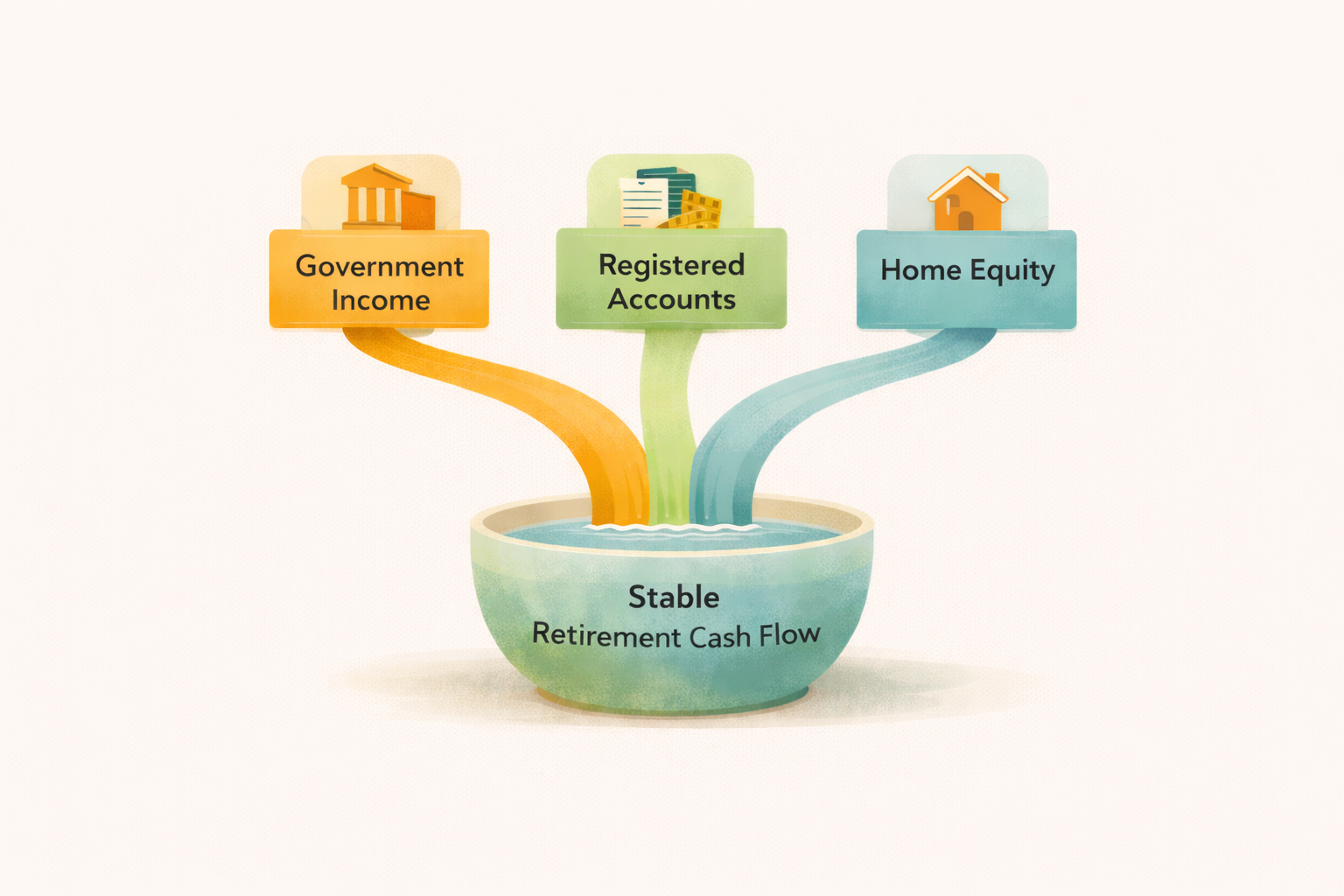
They draw $800 per month from the RRIF (just above the mandatory minimum), make TFSA contributions using some of those draws while room exists, and cover the remaining gap — about $1,100 per month — using a reverse mortgage.
Here's where a lot of people are surprised by how this actually works.
A reverse mortgage is not just a one-time lump sum. It can be structured as a lump sum, a regular monthly draw, occasional draws as needed, or a combination of all three — depending on the lender and what you're trying to accomplish.
The first draw has a minimum of $25,000. After that, you can take money as a recurring monthly deposit, as occasional lump sums when something comes up, or leave the remaining approved amount sitting untouched — available whenever you need it. Interest builds only on what you've actually drawn, not on the full approved limit.
For Donna and Paul, this flexibility matters. They don't need a lump sum. They need a reliable $1,100 a month — something that feels like income, hits their account on schedule, and keeps their cash flow steady without triggering a tax event. The reverse mortgage delivers exactly that.
One lender takes this a step further. They offer an optional charge card — a dedicated card with a set monthly spending limit — where your balance flows directly through to your reverse mortgage at the end of each month. You use it like any other card throughout the month, and the total automatically draws against your approved equity. The card resets each month, and interest builds only on what you've spent.
If Donna and Paul were approved for $200,000 and chose to use this card at a $2,000 monthly limit, spending the full amount each month, that $200,000 approved limit would last roughly 100 months — about eight years — before the full limit is reached. Assuming, of course, they spend the entire $2,000 every month and don't draw from their limit in any other way. In practice, months vary. But the point is: this is a structured, controllable, long-running income supplement — not a desperation move.
The reverse mortgage interest builds on the balance over those years. But the TFSA continues to grow tax-free. The RRIF is drawn down more slowly, reducing mandatory minimum increases later. And neither of them has adjusted their lifestyle at all.
This isn't a strategy pulled from a textbook. It's the kind of planning that happens when advisors and mortgage professionals actually talk to each other — which, in Canada, is less common than it should be.
The Five Things a Reverse Mortgage Can Do in a Retirement Plan
To be clear about where this fits, here is a plain-English summary:
1. Bridge a CPP delay. Cover living costs while CPP grows, then lock in a higher indexed benefit for life.
2. Supplement income without triggering tax. Reverse mortgage draws don't count as income — a critical feature for anyone managing OAS clawbacks or GIS entitlement.
3. Fund a RRIF melt-down strategy. Draw on home equity while you convert RRSP/RRIF to TFSA contributions or pay tax at a lower rate before mandatory minimums grow.
4. Cover irregular large expenses. Medical costs, home renovations, a grandchild's RESP contribution, or any one-time need — without liquidating investments at an inopportune time.
5. Provide a buffer in down markets. Rather than selling investments when markets are down to cover living costs, draw on home equity and leave the portfolio alone to recover.
None of these strategies require abandoning a traditional financial plan. They extend it.
What This Requires
To use a reverse mortgage as part of a retirement income strategy, a few things need to be true:
You own your home and live in it as your primary residence
You are at least 55 years of age
You have meaningful equity (the minimum first draw is $25,000, though you can be approved for significantly more and draw the rest over time)
You have a plan — not just for accessing the equity, but for how it fits with your other income sources
That last point is the most important. A reverse mortgage used without a broader financial plan is just a loan. A reverse mortgage integrated into a proper retirement income strategy can be genuinely useful.
This is where working with both a licensed mortgage professional who specializes in reverse mortgages and a financial advisor who understands the registered account implications is worth the time.
A Final Note
I want to be direct about something.
A reverse mortgage is not a solution to a retirement planning problem that should have been addressed years ago. It's not a substitute for saving. It's not a magic fix.
But for many Canadian homeowners — people who did the work, paid down the mortgage, stayed in the house — it's a meaningful and underused resource. Ignoring it because it feels unfamiliar, or because you heard something once about reverse mortgages at a dinner party, isn't a financial strategy. It's just leaving money on the table.
Your home is an asset. It took decades to build. It deserves to be part of the plan.
[Get Your Free Comparison at Canada Reverse Mortgage Guide →]
This article is for educational purposes only and does not constitute financial, tax, investment, or mortgage advice. Tax rules, benefit thresholds, interest rates, and lender terms change over time and vary by province and individual circumstance. CPP and OAS deferral strategies depend on personal health, life expectancy, and benefit entitlements. TFSA contribution room varies by individual contribution history. All figures used are illustrative only. A licensed Canadian mortgage broker working alongside a qualified financial advisor or accountant can help you model these strategies accurately for your specific situation. All reverse mortgage products are subject to individual lender approval and terms.