What Nobody Tells You About Reverse Mortgage Renewal Rates — Until It's Too Late
Most Canadians who research reverse mortgages focus on one number: the interest rate.
They compare the rate on a reverse mortgage to their current mortgage rate, to HELOC rates, to GIC rates. They ask whether the rate is fixed or variable. They want to know what they will be paying.
What almost nobody asks — because almost nobody knows to ask — is what happens to that rate when the mortgage renews.
This is the question that matters most over a ten or twenty-year horizon. And it is the question that the Canadian reverse mortgage industry, in general, does not volunteer an answer to.
This post does.
How a Reverse Mortgage Term Works
A reverse mortgage, like a conventional mortgage, has a term. In Canada, reverse mortgage terms range from one to five years depending on the lender and product. At the end of each term, the mortgage renews.
During the term, the interest rate is fixed. The balance builds at that rate, semi-annually as required by the Interest Act, and the borrower knows exactly what they are dealing with.
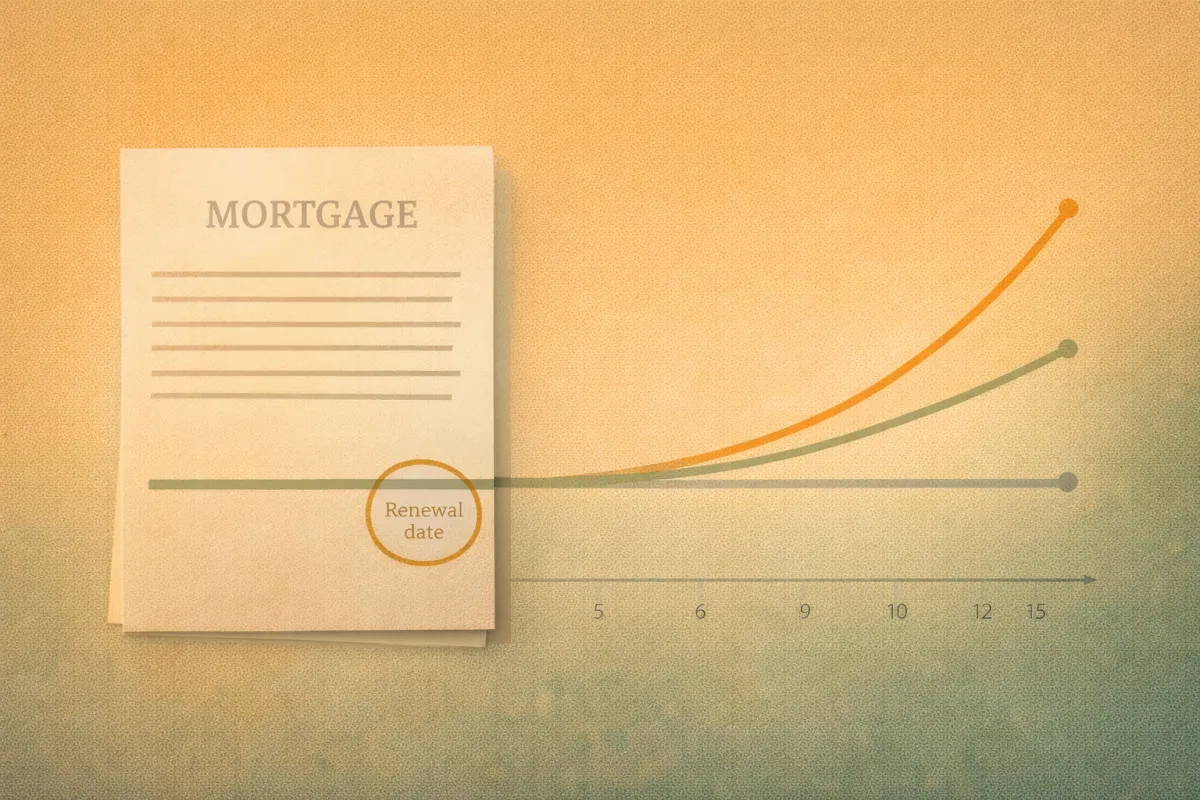
At renewal, the rate resets. The new rate is determined by the lender based on their published rates at the time of renewal — and this is where the lenders diverge significantly.
There are four reverse mortgage lenders in Canada. Their renewal rate structures are not the same. The difference between them, compounded over 15 or 20 years, can be the difference between a manageable balance and a significantly larger one.
The Four Renewal Structures — Named Clearly
Lender A renews above the best available rate at the time of renewal. At renewal, the rate offered to existing borrowers is higher than the rate offered to new borrowers at the same lender. The borrower who signed up years ago, at a rate that seemed reasonable, finds that their renewal rate is not the market rate — it is above it. Over multiple renewal cycles, this adds up.
Lender B renews at best available rate. At renewal, existing borrowers receive the same rate that new borrowers receive. There is no loyalty penalty. The rate is the market rate, whatever it happens to be at the time.
Lender C is newer to the market. Their renewal rate structure is not yet established through a track record of renewals. What they offer at renewal remains to be seen.
Lender D also renews at best available rate — the same as Lender B.
Lender E — a product from the same lender as D — goes further: the rate is locked for life. Whatever rate is established at the time of signing, that rate does not change at renewal. Ever. For the life of the mortgage.
These are not minor distinctions. They are the difference between a product that remains competitive over time and one that quietly becomes more expensive with every renewal cycle.
Why This Matters More Than the Initial Rate
Consider a borrower who takes out a reverse mortgage at age 65. They plan to stay in their home. The mortgage will likely be in place for 15 to 20 years.
Over that period, the mortgage renews three to five times on a five-year term — or significantly more on shorter terms.
Each time it renews with Lender A, the rate resets above market. Each time it renews with Lender B or D, the rate resets at market. With Lender E, the rate never changes.
The initial rate difference between lenders may be small — a fraction of a percent. But the renewal structure difference compounds over time in a way that the initial rate difference does not.
Let's put rough numbers to it — not predictions, but illustrations of the principle.
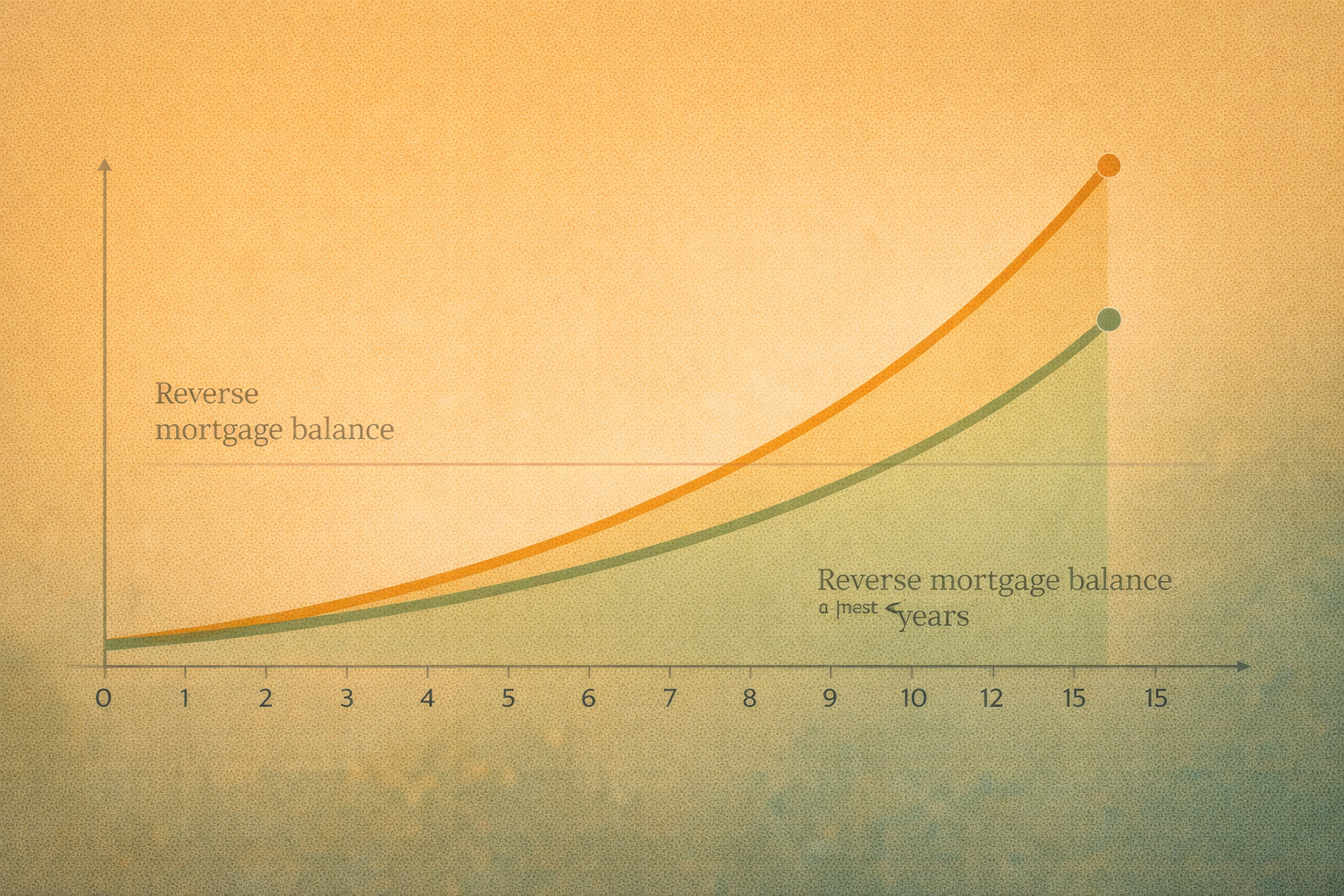
A $300,000 reverse mortgage balance renewing at 1% above market rate versus at market rate is an additional $3,000 per year in interest building on the balance. Over 15 years of renewals above market, that difference — compounded semi-annually — adds tens of thousands of dollars to the final balance.
This is money that comes out of the estate. It is money that reduces what is left for the borrower's family. And it accumulates silently, in the background, with no monthly statement that makes the difference visible.
The Lifetime Rate — What It Actually Means
Lender E's lifetime rate product deserves a specific explanation because it is genuinely unusual in the Canadian market.
When a borrower signs a Lender E reverse mortgage, the rate established at closing is the rate for life. It does not change at renewal. It does not reset to market. It does not go up if rates rise or down if rates fall.
For a borrower who signs during a period of low or moderate rates, this is a significant advantage. If rates rise over the following decade — as they did in Canada between 2022 and 2024 — the Lender E borrower's balance continues to build at the original locked rate while other borrowers are renewing into higher rates.
For a borrower who signs during a period of elevated rates, the lifetime lock is less attractive — there is no opportunity to benefit from a rate decline at renewal.
The value of the lifetime rate product depends entirely on where rates go after signing. Nobody knows where rates will go. But the protection it offers against rising rates over a long horizon is real and worth understanding.
The Conversation That Almost Never Happens
Here is what typically happens in a reverse mortgage consultation in Canada.
The broker — or, in some cases, a lender representative working directly with the consumer — presents the current rate. The borrower asks whether it is fixed or variable. The broker confirms it is fixed for the term. The borrower accepts this.
Nobody asks what happens at renewal. Nobody explains that one lender's renewal rate is above market while another's is at market. Nobody mentions the lifetime rate product as an alternative. The rate that matters most — the long-run renewal rate — is the one that goes unaddressed.
This happens not because brokers are dishonest. It happens because the initial rate is what is visible, and the renewal structure is what requires explanation.
A broker who works with all four lenders and who genuinely understands the long-term implications of each product will raise this unprompted. That is the standard worth holding any broker to.
What This Means for Your Decision
If you are comparing reverse mortgage products — or if you are currently in a reverse mortgage and approaching renewal — here is what to take from this post:
Ask about the renewal rate structure explicitly. Not "what is the rate" — "what happens to the rate at renewal, and how does that compare across all four lenders?"
Model the long-term balance. Ask your broker to show you a projection of the balance at 10 and 20 years under the current rate and under a rate 2% higher. This makes the renewal rate risk visible.
Consider the lifetime rate product. Lender E's lifetime rate is not right for everyone. But for a borrower who expects to hold the mortgage for many years and who wants certainty over rate exposure, it is worth a serious look.
Do not let the initial rate be the only number in the conversation. The initial rate matters. The renewal rate matters more.
A Note on Switching Lenders
It is possible to discharge one reverse mortgage and replace it with another — from a different lender, at a potentially better rate. This involves legal costs, potential penalties, and the administrative work of a new application. It is not free.
But it is an option. And for a borrower who has been in a Lender A product for several years and is approaching renewal into an above-market rate, the question of whether switching is worth the cost is a legitimate one to model. A broker who knows all four lenders can run that comparison honestly.
The Bottom Line
The rate on your reverse mortgage at signing is not necessarily the rate it will carry for the life of the mortgage. In Canada, renewal structures vary significantly between lenders — and that variation, compounded over a decade or more, has a real and measurable effect on the balance that eventually comes out of the estate.
This is the conversation most Canadians never have. Now you have had it.
[Compare All Four Lenders at Canada Reverse Mortgage Guide →]
This article is for educational purposes only and does not constitute financial, tax, investment, or mortgage advice. Reverse mortgage rates, renewal terms, and lender policies change over time. All figures used are illustrative only. A licensed Canadian mortgage broker can provide current rate comparisons and long-term balance projections for your specific situation. All reverse mortgage products are subject to individual lender approval and terms.