
The Reverse Mortgage and Your Net Worth — The Conversation Nobody Is Having
Let me ask you something.
When you think about taking out a reverse mortgage, what do you assume it does to your net worth?
If your answer is "reduces it" — you are in good company. That is what most Canadians assume. It is also, in most situations, wrong.
Not slightly wrong. Meaningfully wrong. And the gap between the assumption and the reality is where some of the most important financial planning conversations in Canadian retirement are waiting to happen.
This post is going to walk through the complete picture — the debt math, the home value math, the cash flow math, the tax math, and finally the planning that makes all of it work the way it should.
It is the longest post on this site. It is also the most important one.
Let's start at the beginning.
Step One — Understanding What Actually Happens to Your Debt
Here is the scenario most Canadian homeowners are actually in when they first consider a reverse mortgage.
They have an existing mortgage. Maybe a modest remaining balance, maybe a more substantial one. They may also have a line of credit, some credit card debt, or a car loan. They are servicing all of this debt every month — payments that are not optional, that leave their account regardless of what else is happening in their financial life.
Now they take out a reverse mortgage.
What happens to the debt?
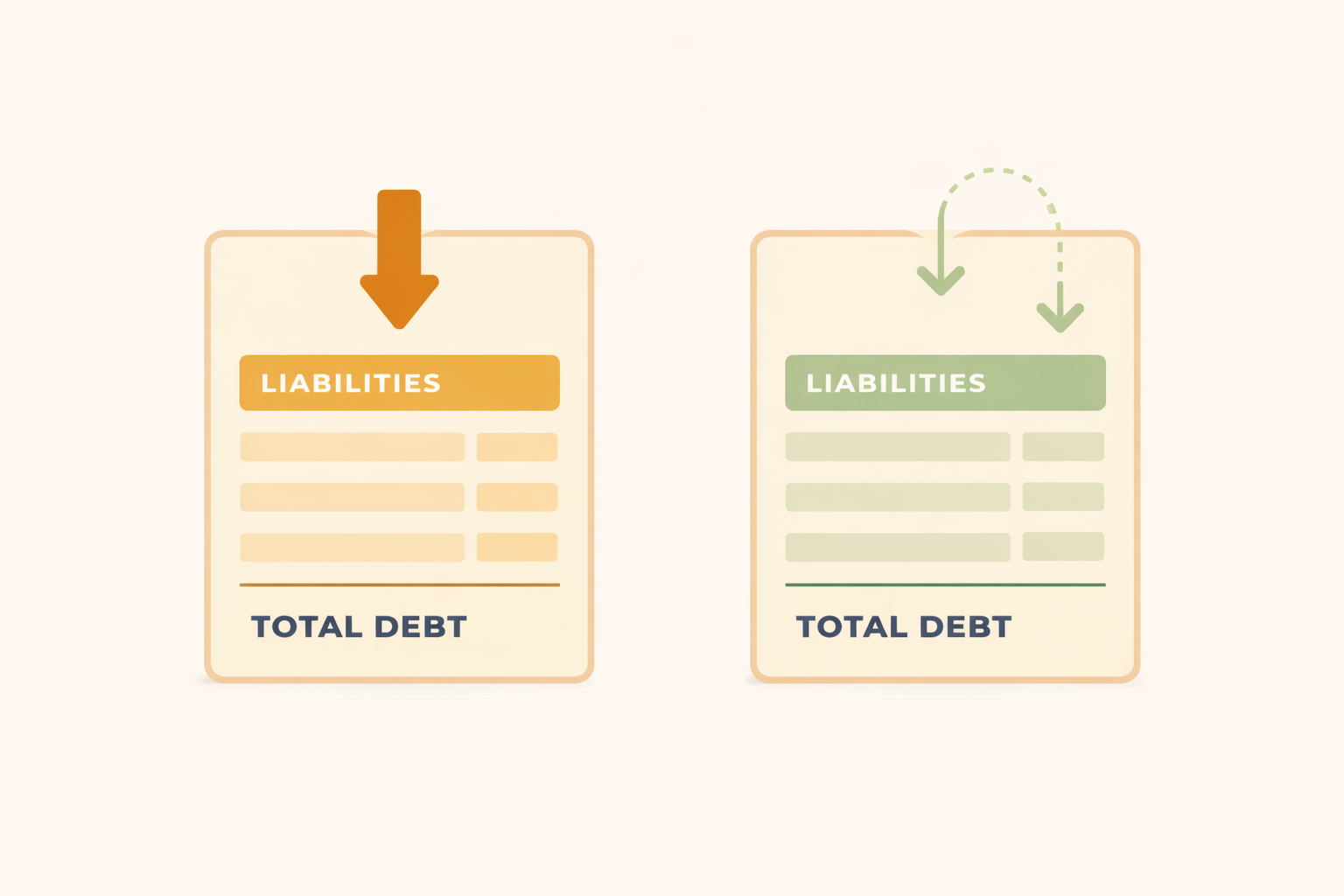
The existing mortgage is paid out from the reverse mortgage proceeds. The consumer debt may be paid out as well. The total debt on their balance sheet on day one of the reverse mortgage is identical — or possibly lower — to what it was the day before.
Read that again.
The debt has not increased. It has been converted. Converted from a structure where payments are mandatory and relentless, into a structure where payments are optional and entirely within the homeowner's control.
This is the insight that changes the entire conversation — and it is the one that almost never gets made clearly.
A reverse mortgage, for most Canadian homeowners, is not a decision to take on new debt. It is a decision to restructure existing debt in a way that is fundamentally more favourable to the borrower.
The balance sheet on day one is essentially unchanged. What has changed is the cash flow. And cash flow, as we will see, changes everything.
Step Two — What Happens to Net Worth Over Time
Now let's look at what happens after day one.
The reverse mortgage balance will grow over time. Interest builds on the outstanding loan balance and is added to it twice a year — semi-annually, as required by the federal Interest Act. Because no payments are required, that interest folds into the balance and the total owed grows gradually.
This is the part that concerns people. And it is worth examining carefully.
The reverse mortgage typically represents somewhere between 20% and just over 50% of the home's value. Let's use 50% as a round number for illustration — understanding that your specific situation will vary and a broker will give you accurate numbers for your profile.
Your home gains value on 100% of what it is worth. Interest builds on roughly 50% of it. That gap is working in your favour.
In most Canadian markets over most reasonable time horizons, the annual gain on the full value of the property has historically been larger than the interest building on the borrowed portion. Not always. Not in every market. Not in every year. But as a general principle — borrowing against a fraction of a home that keeps growing in value tends to preserve and often improve net worth over time.
To put some rough numbers around it — not predictions, because nobody can predict the future, but illustrations of the principle: on an $800,000 home with a $400,000 reverse mortgage, a modest 4% annual gain in home value adds $32,000 to what the property is worth. The interest building on the $400,000 loan, added to the balance twice a year, is a meaningfully smaller number in the early years of the mortgage.
The result — in this illustration — is that net worth has not gone down. It has gone up.
This is not a guarantee. Interest rates, home values, loan amounts, and timelines all vary. There are scenarios where the balance grows faster than the property gains value. Those scenarios are real and a broker will walk through them honestly for your situation.
But the blanket assumption that a reverse mortgage gradually drains your estate is not supported by the numbers in most situations. And in many situations the opposite is true — the estate ends up larger with a reverse mortgage than it would have been without one.
Step Three — The Cash Flow That Changes Everything
So we have established two things. On day one, your debt has been restructured but not increased. Over time, your net worth tends to be preserved or improved by the home value dynamic.
Now let's talk about the cash flow.
Whatever you were previously paying every month — mortgage payments, line of credit interest, consumer debt servicing — is no longer leaving your account on a mandatory basis.
That money does not disappear. It becomes available for you to deploy. And how you deploy it is where the real financial planning conversation begins.
Here are the options — and they are not mutually exclusive:
Make optional payments against the reverse mortgage balance. Every reverse mortgage lender in Canada allows this. The conditions vary by lender — another reason to compare all of them through a broker — but the option exists. Even modest voluntary payments slow the interest building on your balance meaningfully over time. You are in control of the pace rather than the lender.
Contribute to a Tax-Free Savings Account. TFSA growth is completely tax-free. Withdrawals never count as income — which means they never affect your tax bracket, your OAS entitlement, or your GIS eligibility. How much contribution room you have depends on your personal history since the account was introduced in 2009. Not everyone has room available. A financial advisor can confirm your specific situation and whether this option makes sense for you.
Reduce draws from registered accounts. Every dollar you withdraw from an RRSP or RRIF is taxable income. Using reverse mortgage proceeds instead of — or to reduce — those draws can meaningfully lower your annual taxable income, reduce your effective tax rate, and preserve income-tested government benefits.
Protect your OAS entitlement. OAS begins to be clawed back at approximately $90,000 of net income in 2025. If drawing from registered accounts pushes your income toward that threshold, you may be quietly losing benefits you spent a working lifetime earning. Reverse mortgage proceeds do not count as income. Using them strategically can keep your net income below the clawback threshold permanently.
Protect your GIS eligibility. The Guaranteed Income Supplement is income-tested — and reverse mortgage proceeds do not count as income for GIS purposes. For a homeowner who qualifies for GIS, or who would qualify if their reported income were lower, the annual value of this protection can be substantial. This is one of the most underserved conversations in Canadian retirement planning.
Bridge income to defer CPP and OAS. CPP increases by 0.7% for every month you delay past age 65, up to age 70 — an 8.4% annual increase, guaranteed and indexed to inflation, for life. OAS increases by 0.6% per month deferred past 65. Using home equity to bridge your income during the deferral period allows you to lock in a permanently higher lifetime benefit. A financial advisor can model whether this makes sense for your specific health, life expectancy, and benefit entitlements.
Live better. This one does not appear in financial planning documents and it should. Part of the freed cash flow belongs to you — to the retirement you planned for and deserve. Not all of it goes to financial optimization. Some of it goes to living.
The right allocation across all of these uses is a personal decision that depends on your income, your tax situation, your benefit eligibility, your health, and your priorities. A broker working alongside a financial advisor will help you think it through. But the point is clear — the cash flow that a reverse mortgage liberates is not a windfall to be spent without thought. It is a financial planning resource of genuine significance.
Step Four — The Estate Outcome
Let's bring the first three steps together and look at where this lands.
Start with a balance sheet that has been restructured but not worsened. Add a home that keeps gaining value on its full worth while interest builds on only a portion of it. Add the tax savings from reduced registered fund draws. Add the OAS and GIS benefits preserved. Add the lifetime CPP and OAS increase from deferral where applicable. Add the TFSA growth on redirected cash flow where contribution room exists.
The estate outcome in this scenario is not just neutral. In many cases it is genuinely better than it would have been without the reverse mortgage.
This is the claim that surprises people most. It is also the claim that the numbers support most consistently — when the reverse mortgage is used thoughtfully, with a proper plan, by someone who understands what it is and what it is not.
A reverse mortgage cannot protect against financial mismanagement. No financial product can. Spending recklessly, making poor investment decisions, or failing to maintain the property can undermine any tool, however well designed. The reverse mortgage is structurally sound. The plan is what determines the outcome.
Which brings us to the most important section of this post.
Step Five — The Plan. This Is Not Optional.
Here is the part nobody tells you at the kitchen table.
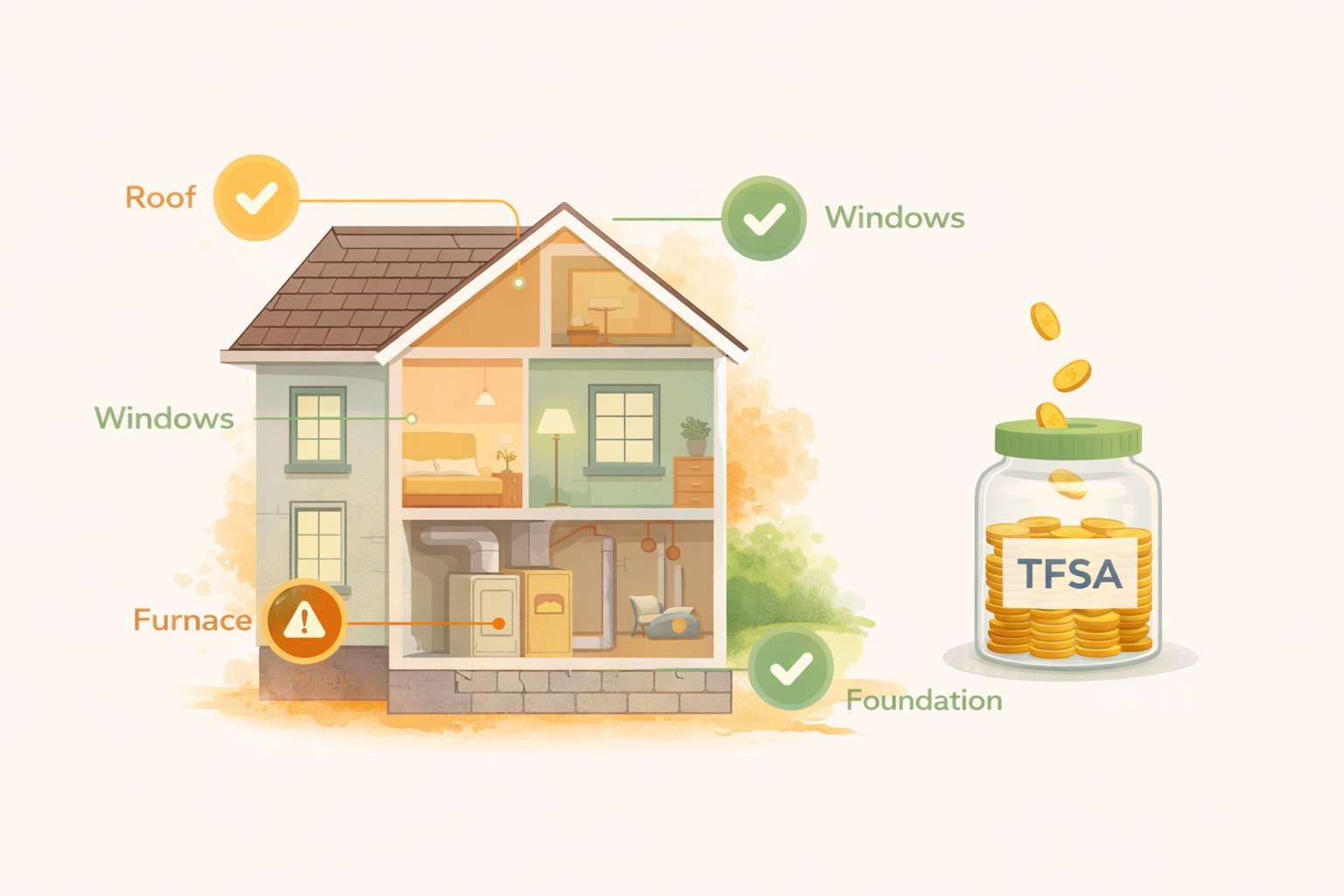
The reverse mortgage itself is not the risk. The roof is the risk. The furnace is the risk. The property tax bill arriving in January when cash flow is tight is the risk. The product is sound. The plan is what matters.
Let me explain what I mean.
A reverse mortgage can go into default in a very small number of ways. The borrower stops paying property taxes. The borrower lets the home insurance lapse. The borrower allows the property to fall into disrepair. The borrower stops occupying the home as their primary residence.
None of these are product failures. They are planning failures. And every single one of them is preventable with a proper plan established on day one.
The Story I Wish I Could Un-Hear
I have spoken with seniors who took every dollar they were approved for on day one. They did not need all of it. But it was available, so they took it. They spent it — sometimes wisely, sometimes not. Years passed.
Then the roof needed replacing. Or the furnace finally gave out. Or the windows had been deteriorating for a decade and could no longer be ignored. They went back to the lender to access additional funds.
The lender sent someone to look at the property. The property was in disrepair. The lender denied additional funds. In the worst cases the lender cited the disrepair as a condition of the mortgage — because maintaining the property in good condition is a standard term of every reverse mortgage — and the homeowner was put into default.
The tragedy is that a planned reserve set aside on day one — growing quietly in a dedicated account, available whenever it was needed — would have prevented all of it. The money was available at the beginning. The plan was not.
This is not a story about a bad product. It is a story about what happens when you take a powerful financial tool and use it without a plan.
The Undrawn Limit Is Not a Reserve — This Matters More Than Most People Know
Here is something most borrowers are never told clearly — and it is one of the most important things in this entire post.
Let's say you are approved for a reverse mortgage of $500,000. Your existing mortgage and debts total $200,000. After paying those out you have $300,000 of remaining limit available to draw.
It is tempting to assume that $300,000 is sitting there waiting for you — a safety net for the roof, the furnace, the windows, whatever comes up down the road.
It is not. Not guaranteed, anyway.
Interest only builds on what you actually draw. The $300,000 you leave undrawn costs you nothing today — and that is genuinely good news. A lower drawn balance means less interest building over time.
But here is the part that matters. That undrawn limit is not a protected reserve. A reverse mortgage lender can re-underwrite your file before advancing additional funds. If the property has deteriorated, your circumstances have changed, or the lender's policies have shifted — they may decline to advance further funds. The limit you did not draw is a potential, not a promise.
This is one of the most important things a broker can tell you — and one of the things most often left unsaid.
Building a Real Reserve — The Right Way
So what do you do instead?
The smart move is to draw a specific, planned amount beyond your immediate needs — perhaps $30,000 to $50,000 depending on your property's age and condition — and set it aside in a dedicated reserve on day one. Yes, interest will build on those funds from the moment you draw them. But they will be yours, accessible, and not subject to re-underwriting when you need them most.
Where that reserve lives depends on your situation — and a financial advisor is the right person to help you decide:
A Tax-Free Savings Account is an excellent home for a maintenance reserve if you have available contribution room. Growth is tax-free and withdrawals never count as income. Not everyone has room — your contribution history since 2009 determines what is available to you. A financial advisor can confirm your specific situation.
GICs or a dedicated savings account are solid alternatives if TFSA room is limited or unavailable. The funds are accessible, guaranteed, and working for you while they wait.
Monthly cash flow set aside systematically — a portion of the payments you are no longer making going into a dedicated account each month — is another option, particularly for someone who prefers to keep the drawn balance as low as possible today.
A combination of the above is often the most practical answer. A financial advisor will help you structure the reserve in the most tax-efficient and accessible way for your specific circumstances.
The specific vehicle matters less than the discipline of having a plan. A funded, accessible reserve for future home maintenance costs is the single most important thing that separates a reverse mortgage that works beautifully for twenty years from one that creates a crisis at year eight.
Plan for the roof before the roof needs replacing. Plan for the furnace before the furnace gives out. The money to do both is available at the time of funding. That is exactly when the plan should be made.
The Planning Questions Every Broker Should Ask
A good broker does not just find you the right lender. They ask the questions that protect you for the next twenty years. Here is what that conversation looks like:
About the property:
How old is the roof? When will it likely need replacing and at what estimated cost?
How old are the windows? The furnace? The hot water heater? The major systems?
Is there deferred maintenance that should be addressed now while funds are available?
What is a realistic estimate of home maintenance costs over the next ten to fifteen years?
About the funding strategy:
Do you need the full approved amount today — or only a portion of it?
How much should be drawn as a dedicated maintenance reserve?
Where should that reserve be held — TFSA if room exists, GIC, savings account, or a combination?
What is the plan for property taxes — current payment, or deferral if available in your province?
About ongoing obligations:
Is your home insurance current and adequate for the property's replacement value?
Do you have a plan for property tax payments going forward?
Is there a family member or trusted person who can help monitor these obligations if needed?
These are not bureaucratic questions. They are the difference between a reverse mortgage that works beautifully for twenty years and one that creates a crisis at year eight.
Property Tax Deferral — The Tool Most Brokers Never Mention
Several Canadian provinces offer property tax deferral programs specifically for seniors. These programs allow eligible homeowners to defer property taxes — with the deferred amount repaid when the home is eventually sold, typically from the sale proceeds.
This is a practical planning tool that fits naturally alongside a reverse mortgage. It removes one of the primary default risks entirely — the property tax obligation — while keeping more cash available for other uses.
Not every province offers this program and eligibility conditions vary. A broker who knows about it will raise it. Many don't. Ask the question before you finalize your funding strategy.
Putting It All Together
Let's return to the question we started with.
What does a reverse mortgage do to your net worth?
On day one — nothing negative. Existing debt has been restructured into a more favourable form. The balance sheet is essentially unchanged. Cash flow has been freed up.
Over time — in most situations, net worth is preserved or improved. Your home keeps gaining value on its full worth while interest builds on only a portion of it. Strategic use of the freed cash flow adds further to the picture through tax savings, benefit preservation, and growth on a planned reserve.
At the end — the estate outcome, when a reverse mortgage is used with proper planning, is frequently better than it would have been without one.
But — and this is the part that matters as much as everything above — none of this happens automatically. It happens because someone asked the right questions at the beginning. Someone looked at the roof and the furnace and the property tax deferral program. Someone drew a planned reserve instead of relying on an undrawn limit that was never guaranteed. Someone built a plan that the reverse mortgage could support rather than undermine.
The reverse mortgage is a tool. A genuinely powerful one. In the right hands, with the right plan, it does something remarkable — it takes the equity locked inside a Canadian home and turns it into a retirement that is more comfortable, more flexible, more tax-efficient, and more financially secure than the alternative.
That is not a sales pitch. That is what the numbers say when you run all of them honestly.
What Should You Do Next?
If this post has shifted how you think about a reverse mortgage — even slightly — the next step is to have the full conversation with someone who knows all four lenders, all six products, and all the planning considerations we have discussed today.
At canadareversemortgageguide.ca you can get a free personalized comparison showing estimates from all six products side by side. It takes about three minutes. Then when a broker calls to walk you through the results, bring this conversation with you.
Ask about the planning. Ask about the reserve. Ask about property tax deferral in your province. Ask which lender gives you the most flexibility to fund strategically rather than all at once.
These are the questions that turn a reverse mortgage from a last resort into a first-rate retirement planning tool.
[Get Your Free Comparison at Canada Reverse Mortgage Guide →]
The information in this post is for educational purposes only and does not constitute financial, tax, investment, or mortgage advice. Tax rules, benefit thresholds, interest rates, and lender terms change over time and vary significantly by individual circumstance. CPP and OAS deferral strategies depend on personal health, life expectancy, and benefit entitlements. TFSA contribution room varies by individual contribution history. All figures used are illustrative only. A licensed Canadian mortgage broker working alongside a qualified financial advisor or accountant can help you model these strategies accurately for your specific situation. All reverse mortgage products are subject to individual lender approval and terms.