
The Reverse Mortgage and the Estate Plan — 4 Things Every Canadian Family Should Discuss
A reverse mortgage is a decision a homeowner makes about their own money, their own home, and their own retirement. It belongs to them. The decision is theirs.
But it has implications for other people — specifically, the people who will eventually be part of settling the estate. And those implications, if they are not discussed in advance, have a way of becoming surprises at the worst possible time — during grief, during estate administration, when the family is least equipped to absorb unexpected information.
The families who navigate this well are not the ones who avoided the conversation. They are the ones who had it.
Here are the four things worth discussing.
1. What the Reverse Mortgage Actually Is — and What It Means for the Estate
The starting point for any family conversation is a shared understanding of the basic facts. In practice, adult children often have only a vague or inaccurate sense of how a reverse mortgage works — and the gap between what they imagine and what is actually true tends to generate more anxiety than the reality warrants.
The facts worth sharing clearly:
The home stays in the parents' name. A reverse mortgage is a loan secured against the home, not a transfer of ownership. The parents own it. They live in it. The lender holds a mortgage — in the same way as a conventional mortgage lender. The home does not belong to the lender.
The balance grows over time. Interest builds on the outstanding amount semi-annually. The longer the mortgage is in place, the larger the balance. This is the part most adult children are vaguely aware of and most anxious about. Naming it directly — with actual numbers, not just the concept — removes the anxiety of the unknown and replaces it with the manageable reality.
The estate receives the remainder. When the home is eventually sold, the outstanding reverse mortgage balance is repaid first. What remains — which in most situations is still a meaningful amount — goes to the estate. The no negative equity guarantee means the estate will never owe more than the home is worth at the time of sale.
Having these facts on the table — calmly, specifically, with actual numbers from the lender's projection — is the foundation of every other conversation.
2. What the Balance Will Likely Be — and What That Means for Each Beneficiary
This is the conversation most families avoid because it requires putting specific numbers on an outcome that feels uncomfortable to contemplate. But it is the most practically useful conversation to have.
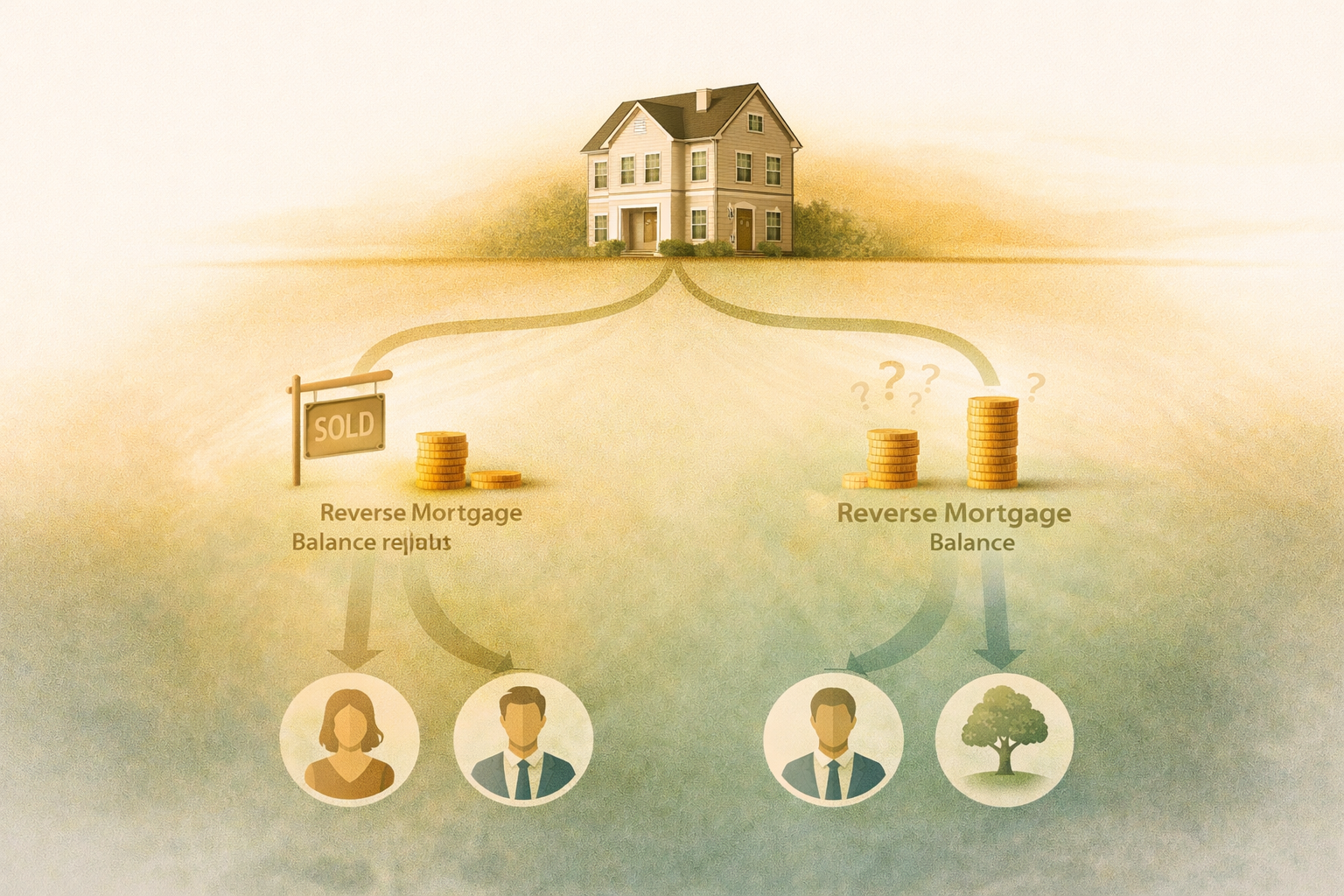
The reverse mortgage lender can provide a balance projection — what the outstanding amount is likely to be at 5, 10, and 15 years from now under current rates and under a higher rate scenario. This projection is not a prediction. It is a planning tool.
With that projection in hand, the family can work through what the estate distribution will likely look like under different scenarios:
If the home is sold in 5 years, the balance will be approximately X. At a current estimated home value of Y, the net estate proceeds from the home will be approximately Z.
If the home is sold in 15 years, the numbers look different.
If the home gains value faster than the balance grows, the net equity may actually be higher than today in absolute terms.
This is not a morbid exercise. It is responsible planning. Adult children who understand what to expect are far less likely to be caught off guard during estate settlement — and far more likely to support the reverse mortgage decision with full understanding rather than partial information.
If the will makes specific bequests that depend on assumptions about the home's value, those assumptions should be revisited in light of the projected balance. This is a conversation for the estate lawyer.
3. Who Is Responsible for What — and What Happens If Something Changes
A reverse mortgage has ongoing conditions that must be maintained for the mortgage to remain in good standing: property taxes paid, home insurance current, property maintained in good condition, home occupied as primary residence.
These conditions continue regardless of the borrower's health, cognitive capacity, or living situation. Planning for what happens if maintaining them becomes difficult is not pessimism — it is the practical work of estate and capacity planning.
The questions worth discussing as a family:
Who is the power of attorney for property? That person takes on responsibility for the mortgage conditions if the parent becomes incapable of managing their own affairs. Do they know a reverse mortgage is in place? Do they understand what the conditions are?
What is the plan if the parent needs to move temporarily or permanently? A short-term absence — for a hospital stay, a rehabilitation period, travel — is generally permitted under the terms of most reverse mortgages. A permanent move to a care facility is a triggering event that accelerates repayment. The family should understand this distinction and have a plan for managing the property if and when that transition happens.
Who will oversee the property maintenance? If the parent's mobility or capacity changes and they can no longer manage the home maintenance themselves, who steps in? This is partly a practical question about who lives nearby and has the capacity to help. It is also a financial question — home maintenance costs money, and a property that falls into disrepair risks the mortgage conditions.
Is there a trusted person who can monitor the property tax and insurance payments? As discussed in Post 18, administrative failures — a missed property tax payment, a lapsed insurance policy — are among the most common ways a reverse mortgage goes into default. Identifying someone who can keep an eye on these obligations is simple, practical, and prevents a significant category of problems.
4. The Rationale — Why This Decision Was Made
This last conversation is perhaps the most important and the most often skipped.
Adult children who understand the reasoning behind a reverse mortgage decision are far more likely to support it — during the parent's lifetime and during estate settlement — than those who learn about it after the fact and have to reconstruct the reasoning from the outside.
The conversation does not need to be elaborate. It can be as simple as:
"We're doing this because our income doesn't fully cover what we need, and we don't want to sell the house. The reverse mortgage lets us stay and have the financial breathing room we need. We know it means there will be less for you when the time comes, and we want you to understand why we think it's the right decision for us."
That sentence — honest, specific, and addressed directly to the people it affects — does more to prevent family conflict during estate administration than any legal document.
The estate lawyer can draft the will. The financial advisor can model the projections. But the conversation that makes all of it work is the one that happens at the kitchen table between people who love each other.
When to Have These Conversations
Before the reverse mortgage is signed is the ideal time. The balance is zero. The projections are a planning tool, not a current reality. The decision has not yet been made and everyone has the opportunity to be part of the process with complete information.
After signing is still much better than never. The conversation can happen at any point while the parent is alive and capable of having it. A letter of instruction to the executor — prepared by the estate lawyer alongside the will — can document the essential facts and the rationale in written form so they are available even if the oral conversation is never fully had.
The one outcome to avoid is the adult children learning about the reverse mortgage for the first time during estate administration, after the parent has died, when there is no opportunity to ask questions or understand the reasoning. That outcome is preventable with a single honest conversation. It is worth having.
A Plain-English Summary
Four things to discuss as a family when a reverse mortgage is part of the picture:
1. What it is and what it means for the estate — the basic facts, clearly stated.
2. What the balance will likely be — actual projections, not just the concept.
3. Who is responsible for what — POA, property conditions, maintenance oversight.
4. The rationale — why the decision was made, directly and honestly.
These are not difficult conversations. They are the ones that prevent difficult situations later.
[Get Your Free Comparison at Canada Reverse Mortgage Guide →]
This article is for educational purposes only and does not constitute financial, tax, legal, or mortgage advice. Estate planning, power of attorney, and reverse mortgage terms vary by province and individual circumstance. Consult a qualified estate lawyer and financial advisor for advice specific to your situation. All reverse mortgage products are subject to individual lender approval and terms.