
12 Questions Every Canadian Should Ask Before Signing a Reverse Mortgage
A reverse mortgage is a significant financial decision. It involves the most valuable asset most Canadians own, it will likely be in place for years or decades, and its terms — particularly the renewal rate structure — can have a meaningful impact on the outcome.
The right broker will not be threatened by questions. They will welcome them. If you are sitting across from someone who rushes past your questions, dismisses your concerns, or makes you feel that asking is an inconvenience — that is useful information about whether this is the right person to trust with this decision.
Here are the 12 questions worth asking before you sign anything. Bring this list to your consultation.
1. How many lenders are you able to work with, and are you comparing all of them for me?
There are four reverse mortgage lenders in Canada offering six products. The terms — interest rates, renewal rate structures, draw flexibility, optional payment conditions — vary meaningfully between them.
A broker who only works with one or two lenders is not giving you a complete picture. You want a broker who has access to all four lenders and who will show you the comparison across all of them before recommending one.
The right answer: all four lenders, all six products, side by side. Anything less, ask why.
2. What is the interest rate — and what happens to it at renewal?
The rate at which your balance builds is the most important number in a reverse mortgage. But the initial rate is only half the story.
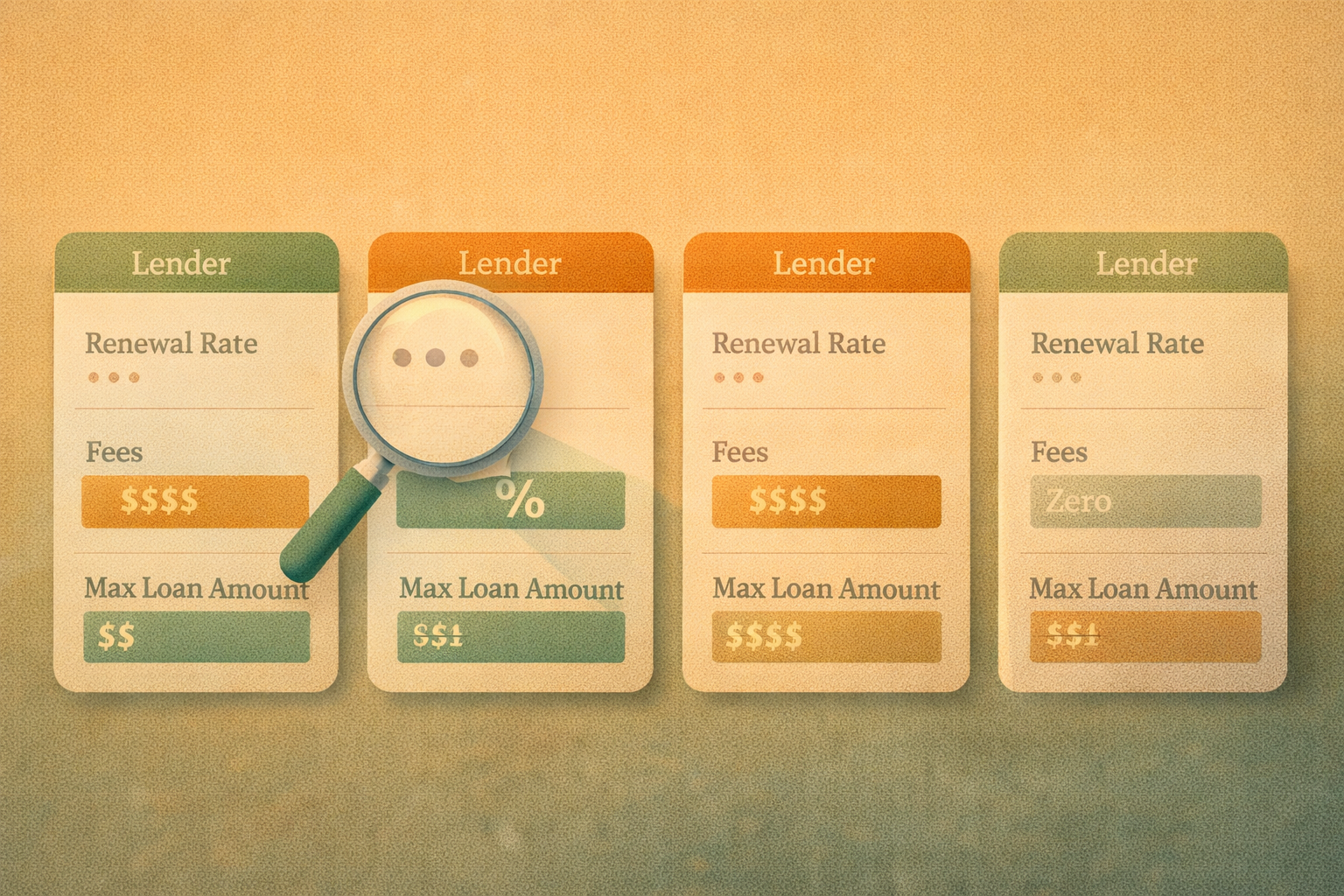
Every reverse mortgage has a term — typically one to five years — after which it renews. The renewal rate matters enormously over a 10 or 20-year horizon. One lender in Canada renews above the best available rate at the time of renewal. Others renew at the best available rate. One product locks in the rate for life.
Ask specifically: what rate am I being quoted today, and what happens to that rate when the mortgage renews? Do not let this question be answered vaguely.
3. What is the minimum I need to draw, and how can I structure the draws going forward?
The minimum first draw is $25,000. After that, the structure is flexible — lump sum, monthly recurring, occasional draws, or a combination.
Ask: can I set up a monthly draw? Can I change the amount later? Can I make occasional draws without setting up a recurring payment? Is there a minimum for subsequent draws after the first?
Understanding the draw structure helps you plan how the reverse mortgage will actually function in your day-to-day financial life.
4. Can I make voluntary payments — and are there any conditions or limits?
Every Canadian reverse mortgage lender allows voluntary payments. The conditions vary. Some lenders allow any amount at any time with no penalty. Others have specific conditions — a minimum payment amount, a particular payment window, or restrictions on frequency.
Ask: can I make payments whenever I choose? Is there a minimum? Are there any penalties or conditions I should know about?
For borrowers who are accustomed to making regular payments and want to manage their balance actively, understanding these terms before signing is important.
5. What fees are involved — upfront and ongoing?
A reverse mortgage involves closing costs. These typically include an appraisal fee, independent legal advice (which every lender requires and every borrower should take seriously), title insurance, and potentially an origination or setup fee depending on the lender and product.
Ask for a clear, written breakdown of all fees before signing. Understand which fees are paid from the mortgage proceeds and which may be due out-of-pocket. Ask whether there are any ongoing fees — annual administration charges, draw fees, or others.
There should be no surprises on the closing statement.
6. What are the conditions that would put the mortgage in default?
A reverse mortgage can go into default in a small number of specific ways: failure to pay property taxes, allowing home insurance to lapse, permitting the property to fall into disrepair, or ceasing to occupy the home as the primary residence.
Ask your broker to explain each of these clearly. Ask what the lender's process is if one of these conditions is at risk of occurring — is there a cure period, a notice requirement, an opportunity to correct the situation before default is triggered?
Understanding the default conditions is not pessimistic. It is responsible. These conditions are all preventable with good planning.
7. What happens when the mortgage renews — and is renewal guaranteed?
At the end of each term, the reverse mortgage renews. Ask: is renewal automatic? Can the lender decline to renew? Under what circumstances might renewal be declined or terms changed?
For the no-payment term product (Lender F), renewal is not guaranteed and a full file review is conducted at term end. For the reverse mortgage products, renewal is generally automatic provided the borrower continues to meet the basic conditions of the mortgage. Confirm the specific renewal terms for the product being recommended.
8. What is the no negative equity guarantee — and does it apply to this product?
All four Canadian reverse mortgage lenders offer a no negative equity guarantee, which means the borrower will never owe more than the home is worth when it is sold. The estate is protected even if the balance has grown beyond the sale price.
Ask: does this guarantee apply to the specific product being recommended? What are the exact conditions? Are there any circumstances under which it would not apply?
This is one of the most important consumer protections in the product. Confirm it in writing.
9. How does the interest build — daily, monthly, or semi-annually?
In Canada, reverse mortgage interest is required by the federal Interest Act to compound semi-annually — twice per year. This is more favourable than a HELOC, where interest is calculated daily and charged monthly.
Ask your broker to confirm the compounding frequency for the specific product being recommended and to explain the practical difference between semi-annual compounding and the alternatives.
10. What does my balance look like at 5, 10, and 15 years — at current rates and at higher rates?
Ask the broker to model the balance growth under at least two scenarios: the current rate continuing, and a rate that is meaningfully higher — say, 2% above current. This gives you a realistic sense of how the balance may grow under different conditions.
A good broker will produce this projection without being asked. If they are reluctant to show you the downside scenario, that is a signal worth paying attention to.
11. What should I do with the funds I am not drawing immediately?
If you are approved for more than you need right now — which is common — ask your broker what they recommend for the undrawn portion. Should it sit as available credit? Should you draw a reserve and hold it elsewhere? What are the tax and income implications of different approaches?
As discussed elsewhere on this site, the undrawn limit is not a guaranteed reserve — a lender can re-underwrite the file before advancing additional funds. A planned, drawn reserve held in a TFSA or dedicated savings account is more reliable than relying on an undrawn limit. Your broker should raise this proactively. If they do not, raise it yourself.
12. What is your recommendation — and why this lender and not the others?
After going through the comparison, ask your broker directly: which product are you recommending for my situation, and why specifically is it better than the alternatives?
A confident, specific answer — grounded in the details of your situation, your age, your property, your draw requirements, and your plans — is what a good recommendation looks like. A vague answer, or one that defaults to a single lender without comparison, is not.
You are entitled to understand the reasoning. And if the reasoning holds up under a few follow-up questions, you have a broker worth trusting.
A Note on Independent Legal Advice
Every Canadian reverse mortgage lender requires the borrower to obtain independent legal advice (ILA) before the mortgage is finalised. This is a consumer protection requirement. The lawyer who provides ILA is there to make sure you understand what you are signing — they are not your broker's lawyer or the lender's lawyer. They are yours.
Take this seriously. Use the ILA appointment to ask any remaining questions you have about the specific terms of the mortgage document. This is the last checkpoint before signing.
Using This List
These 12 questions are not a test your broker needs to pass. They are a framework for having a complete conversation — one that leaves you genuinely informed rather than simply reassured.
A broker who answers all 12 clearly, specifically, and without defensiveness has earned your confidence. That is exactly the kind of broker you want advising you on the most valuable asset you own.
[Book Your Free Consultation at Canada Reverse Mortgage Guide →]
This article is for educational purposes only and does not constitute financial, tax, investment, or legal advice. Reverse mortgage terms, fees, and lender conditions vary and change over time. Independent legal advice is required by all Canadian reverse mortgage lenders. All reverse mortgage products are subject to individual lender approval and terms.