How Canadian Reverse Mortgage Rates Are Set — and Why the Number You See Today Isn't the Whole Story
The rate question is almost always the first one.
"What's the rate?" It is the natural starting point for anyone evaluating a financial product. It is a reasonable question. And it deserves a complete answer — not just the number, but what the number reflects, how it compares to the alternatives, what happens to it over time, and why focusing on the initial rate alone misses most of what actually matters.
This post provides the complete answer.
How Reverse Mortgage Rates Are Actually Set
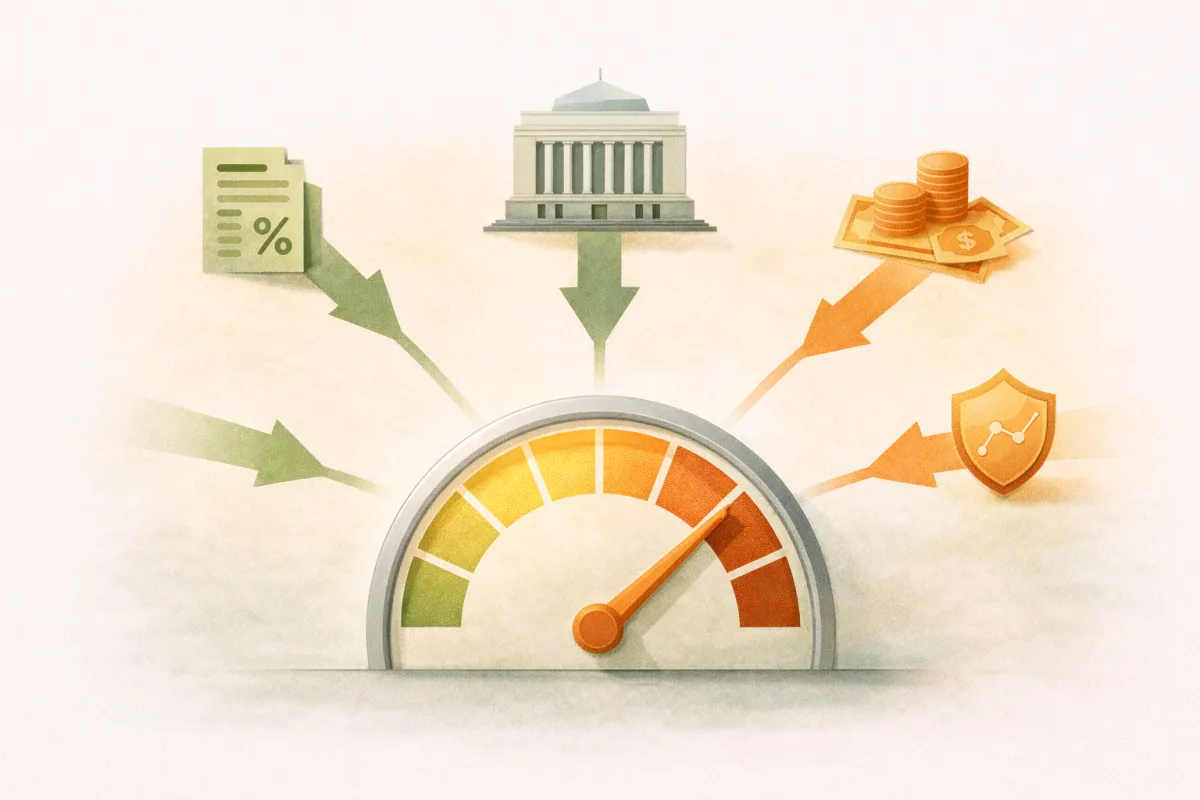
Reverse mortgage rates in Canada are set by the lenders — not by the Bank of Canada, not by a government regulator, and not by a formula that is publicly disclosed. Each lender sets their own rate based on their own cost of funds, their own risk assessment, and their own competitive positioning.
That said, the factors that drive the rate are broadly understood:
The lender's cost of funds. Reverse mortgage lenders fund their loan books by borrowing — through bond issuances, institutional funding, or other capital market instruments. The cost of that funding influences the rate they charge borrowers. When the cost of funds rises, reverse mortgage rates tend to rise. When it falls, rates tend to follow.
The risk profile of the product. A reverse mortgage is a unique credit instrument. The lender cannot demand repayment or require monthly payments. The balance grows over time. The repayment is deferred until a triggering event — sale, permanent move, or death. This deferred-repayment, growing-balance structure carries risks that conventional mortgage lending does not — and those risks are priced into the rate.
The longevity and property value uncertainty. The lender is ultimately dependent on the property being worth more than the outstanding balance when the loan is eventually repaid. The longer the mortgage is in place and the more the balance grows, the more dependent the lender is on property appreciation to protect their position. This uncertainty is a component of the rate premium over conventional mortgage rates.
Competitive positioning. With four lenders in the Canadian market, there is competitive pressure on rates. Lenders monitor each other's rates and adjust accordingly. The spread between lenders at any given time is typically modest — less than a full percentage point — because the competitive dynamics constrain how far any one lender can move from the others without losing market share.
The result: reverse mortgage rates in Canada are typically 1.5% to 2.5% higher than conventional 5-year fixed mortgage rates at the same time. The premium reflects the product's risk profile, not arbitrary pricing.
How Reverse Mortgage Rates Compare to the Alternatives
The rate on a reverse mortgage is not evaluated in isolation. It is evaluated against what the alternative costs — and the alternatives are often more expensive than they appear.
Versus a HELOC: A HELOC rate is typically prime plus a lender-specific margin — usually prime plus 0.5% to 1%. In many rate environments, this produces a rate that is lower than the reverse mortgage rate on paper.
But the comparison is not just about the rate. A HELOC charges interest daily and requires at minimum a monthly interest payment. A reverse mortgage charges interest semi-annually and requires no monthly payment. The effective cost difference over time is smaller than the rate difference suggests — and for a borrower who cannot or does not make the monthly HELOC payment, the HELOC rate is academic.
Additionally, a HELOC is callable. As discussed in Post 9, the lender can freeze, reduce, or close a HELOC at any time for any reason. A reverse mortgage is not callable. The structural security of the reverse mortgage has value that does not appear in a simple rate comparison.
Versus a conventional mortgage: A conventional mortgage rate is lower than a reverse mortgage rate. But a conventional mortgage requires income qualification and mandatory monthly payments. For a retiree on a fixed income who cannot qualify for a conventional mortgage, the conventional rate is not available — the only relevant comparison is between the reverse mortgage and the alternatives that are actually accessible.
Versus credit card debt: At 20% or higher, credit card debt makes a reverse mortgage look inexpensive by comparison. Converting $20,000 of credit card debt to a reverse mortgage balance is a meaningful improvement in the cost of that debt, regardless of the absolute reverse mortgage rate.
Versus investment returns: The comparison sometimes made is: "My investments are returning X% — should I draw down investments or take a reverse mortgage at Y%?" This comparison is incomplete because it ignores the tax consequences of investment liquidation and the OAS/GIS implications of registered account draws. The after-tax comparison often favours the reverse mortgage even when the pre-tax rate comparison does not.

The Compounding Structure — Why Semi-Annual Matters
In Canada, the Interest Act requires that mortgage interest compound no more frequently than semi-annually — twice per year. This applies to reverse mortgages. The practical effect is that interest is calculated and added to the balance twice per year, not daily or monthly.
This is more favourable than a HELOC, where interest is calculated daily and charged monthly. It is far more favourable than a credit card, where interest is calculated daily at rates typically around 20%.
To illustrate the difference: on a $200,000 balance, the difference between daily compounding at the HELOC rate and semi-annual compounding at the reverse mortgage rate narrows significantly over time compared to the nominal rate difference. The compounding frequency advantage partially offsets the rate premium.
This does not make reverse mortgage rates "cheap." They are not. But the semi-annual compounding structure is meaningfully more favourable than the daily compounding of the alternatives, and it should be part of any honest rate comparison.
Fixed Rates and What "Fixed" Actually Means
Reverse mortgage rates are fixed for the term — typically one to five years depending on the lender and product. During the term, the rate does not change. The balance builds at a known, predictable rate.
At the end of the term, the mortgage renews and the rate resets to whatever the lender is offering at that time.
This is the part that matters most over a long horizon — and the part that is discussed least in most reverse mortgage conversations.
As covered in detail in Post 16, the renewal rate structure varies significantly between lenders. One lender renews above the best available rate. Two renew at market rate. One product locks the rate for life.
The initial rate is one number at one point in time. The renewal rate structure is what the mortgage will actually cost over 10, 15, or 20 years. These are not the same thing. A borrower who focuses only on the initial rate and ignores the renewal structure is making a decision based on incomplete information.
What Drives Rates Over Time
For a borrower planning to hold a reverse mortgage for many years, the question of what drives rates over time is worth understanding.
Canadian reverse mortgage rates are influenced by:
The Bank of Canada overnight rate. When the Bank of Canada raises or lowers its policy rate, this influences the cost of funds for lenders across the market — including reverse mortgage lenders. Reverse mortgage rates do not move in lockstep with the overnight rate, but they are influenced by it over time.
Government of Canada bond yields. Lender funding costs are also influenced by longer-term bond yields. When 5-year Government of Canada bond yields rise, the cost of fixed-rate mortgage funding tends to rise with it — including reverse mortgage rates.
Competitive dynamics. With more lenders in the market than there were five years ago, competitive pressure has become a more meaningful factor in rate-setting. New entrants have introduced rate competition that was not present when there was effectively one dominant lender.
Property market conditions. In periods of significant property value uncertainty, lenders may widen their rate premium to compensate for increased risk. In stable or appreciating markets, the premium may narrow.
None of these factors produce predictable rate movements. Rates can go up or down based on conditions that no borrower or lender can fully anticipate. The lifetime rate product from one lender exists precisely because some borrowers want to remove this uncertainty entirely.
The Question Worth Asking
When you see a reverse mortgage rate quoted — whether from a lender, a broker, or a comparison website — the useful question is not just "what is it?" but:
What is the renewal rate structure for this product?
What would the balance look like at 10 and 15 years at this rate, and at this rate plus 2%?
How does this compare across all four lenders — not just the initial rate but the renewal structure?
Is the lifetime rate product worth considering for my situation?
The number you see today is the starting point. The renewal structure and the long-term balance projection are the complete picture.
[Compare All Four Lenders at Canada Reverse Mortgage Guide →]
This article is for educational purposes only and does not constitute financial, tax, investment, or mortgage advice. Reverse mortgage rates, lender terms, and product availability change over time. All figures used are illustrative only. A licensed Canadian mortgage broker can provide current rate information and long-term balance projections for your specific situation.