
5 Ways Canadians Are Using Home Equity to Eliminate Debt in Retirement
Nobody plans to carry debt into retirement.
But most Canadians do. A mortgage that wasn't quite paid off. A line of credit that grew during the income years and never quite shrank. Credit card balances that accumulated during a medical event, a home repair, a period when things were tight. Car loans. HELOC balances. Consumer debt that outlasted the spending that created it.
According to data from Statistics Canada and various consumer finance surveys, a significant and growing proportion of Canadians are entering retirement with meaningful debt loads. The combination of longer working years, rising housing costs, and the normalisation of credit as a financial tool means that arriving at 65 with a clean balance sheet is increasingly the exception rather than the rule.
This matters more in retirement than it did during your working years. When you were earning a salary, debt payments were annoying but manageable. In retirement, on a fixed income, they are a structural problem. Every dollar leaving your account to service debt is a dollar that cannot go to living, to health, to the things retirement is supposed to be for.
For Canadian homeowners 55 and older, there is a tool that addresses this problem directly. Here are five ways people are using it.

1. Paying Off the Remaining Mortgage
This is the most common use case, and the one that produces the most immediate and tangible result.
Many Canadians arrive at their late 50s or early 60s with a small-to-moderate mortgage balance still outstanding — perhaps $80,000, $120,000, $200,000. They have been making payments for decades. The balance is manageable in the abstract but it represents a mandatory monthly obligation that does not disappear when employment income does.
A reverse mortgage pays out the existing mortgage from the proceeds. The balance on the balance sheet is essentially unchanged — the debt has been converted, not eliminated. But the mandatory monthly payment disappears entirely. What was a required payment becomes optional. The cash flow improves immediately and permanently.
For someone moving from employment income to CPP and OAS, this change in cash flow can be the difference between a retirement that works and one that doesn't.
The key insight — the one that surprises most people — is that the total debt on day one is the same before and after the reverse mortgage. You have not borrowed more. You have restructured what you already owed into a form that is far more retirement-friendly.
2. Eliminating a HELOC Balance
Home equity lines of credit are useful during your working years. They are flexible, relatively inexpensive, and available when you need them.
They are also calculated at a variable rate, charged interest daily, and require at minimum the monthly interest payment — every month, indefinitely, for as long as the balance remains.
In retirement, a HELOC balance that made sense during the income years becomes a different kind of problem. The balance may not be large. But the interest charges don't stop, the required payment doesn't stop, and the rate — tied to prime — can move against you at any time.
A reverse mortgage can pay out a HELOC balance at closing. The HELOC is closed or reduced to zero. The interest charges stop. The required payment stops. The variable rate risk disappears.
Again — the debt itself has been converted, not eliminated. The reverse mortgage balance will build interest over time. But the interest on a reverse mortgage builds semi-annually, as required by the federal Interest Act — not daily as a HELOC does. And there is no mandatory payment requirement. The structure is categorically more retirement-friendly than a HELOC balance that keeps running.
3. Clearing High-Interest Consumer Debt
Credit card debt in retirement is more common than most people will admit, and more damaging than most people realise.
At rates of 19.99% or higher, credit card interest builds on an outstanding balance with brutal efficiency. A $20,000 balance at 20% interest costs $4,000 per year in interest alone — over $330 per month — before a single dollar of principal is repaid.
For a retiree on a fixed income, this is not a minor inconvenience. It is a genuine financial emergency in slow motion.
A reverse mortgage can provide the lump sum needed to clear a credit card balance entirely. The high-interest obligation disappears. The monthly cash flow improves by the amount of the former minimum payment. The psychological weight of the debt — which is real and measurable and affects decision-making — is gone.
The reverse mortgage balance builds interest at a rate that, while higher than a conventional mortgage, is a fraction of credit card rates. Converting $20,000 of credit card debt into $20,000 of reverse mortgage balance is not a neutral transaction — it is a meaningful improvement in the cost of that debt.
4. Paying Off a Car Loan or Other Consumer Debt
Car loans, personal loans, financing agreements — these are fixed-payment obligations with fixed terms. They do not flex to accommodate a changed income. They leave your account on the same date every month whether you can afford them or not.
In retirement, these payments compete directly with necessities. Groceries. Utilities. Medications. The things that do not negotiate.
A reverse mortgage can provide the funds to pay off a car loan or personal loan in full, eliminating the fixed payment entirely. The logic is the same as the credit card case: the debt has been converted from a high-cost, mandatory, fixed-payment structure into a lower-cost, optional-payment structure that fits the reality of retirement income.
This is not a strategy to use for small debts that are nearly paid off. If the car loan has six months left on it, riding it out is almost certainly the better answer. The reverse mortgage is most useful for debts that have meaningful time and cost remaining.
5. Consolidating Multiple Debts Into One Manageable Structure
For some people, the problem is not one large debt but several smaller ones that collectively create a payment burden that the retirement income cannot support.
A mortgage with a modest balance. A HELOC that was used for a renovation. A car payment. A credit card that carries a running balance. Individually, each is manageable. Together, they consume a significant portion of a fixed monthly income before a single discretionary dollar is spent.
A reverse mortgage can pay out all of them at once. The individual payment obligations disappear. What remains is a single reverse mortgage balance that builds interest semi-annually and requires no mandatory payment.
The total debt is similar to what it was before — debt consolidation does not make debt disappear. But the cash flow picture transforms immediately. The monthly obligations that were consuming retirement income are gone. The money stays in the account. Retirement becomes affordable again.
The HELOC Income Trap — A Risk Most People Never See Coming
There is a specific situation that deserves its own section, because it is both extremely common and extremely dangerous.
It happens most often between ages 65 and 75. The pension isn't quite enough. CPP and OAS cover the basics but not the gaps. So the HELOC — which was always there, always available — becomes a quiet supplement. Not a major draw. Just a hundred dollars here, two hundred there. A $150 shortfall covered at the end of the month. Groceries when the account runs low. A utility bill that arrives at a bad time.
It feels manageable because each individual draw is small. But small draws in an inflationary environment, repeated monthly, over years, on a variable-rate loan that charges interest daily, add up to something that is not manageable at all. The balance creeps. The interest charges grow. The minimum payment increases. And the person who started drawing $150 a month to cover shortfalls is now paying hundreds a month just to service the interest on the draws that covered those shortfalls.
That is the slow version of the problem.
And here is what makes it worse in a rising rate environment.
A HELOC is a variable rate product tied to prime. When prime goes up, the rate on the HELOC goes up — and that increase takes effect within the next billing cycle, sometimes within 30 days. There is no fixed rate, no notice period, no buffer. The payment due increases immediately.
For someone borrowing from a HELOC to cover monthly shortfalls, a rate increase is not an abstract concern. It is a direct reduction in disposable income. The interest charge goes up. That means less money available for living expenses. Which means more borrowing from the HELOC to cover the gap. Which increases the balance. Which increases the interest charge. Which means less money again.
This is what we call payment and balance creep.
The balance grows. The required interest payment grows. The disposable income shrinks. The draw required to cover the shortfall grows. The balance grows further. Rates go up again. Repeat.
People sometimes say that a reverse mortgage balance grows over time — as a criticism. They are right that the balance grows. But a person borrowing from a HELOC to live is in a balance-growth situation too. The difference is that the HELOC spiral is driven by a variable rate that can move against the borrower at any time, a mandatory payment that increases with every rate rise, and a credit facility that can be closed the moment the borrower is most dependent on it.
When someone reaches their HELOC limit — or when the lender freezes or reduces it — the spiral does not stop cleanly. It stops because there is nothing left to borrow. That is a very different ending than choosing to stop.
Here is the fast version.
A HELOC is a callable loan.
Most Canadians do not know this. The lender can close the HELOC, freeze it, or reduce the limit at any time, for any reason, with no obligation to explain why. It does not require a missed payment. It does not require a change in your financial situation. It can happen because the lender has changed its lending policies, because the real estate market has shifted, because a portfolio review flagged your file, or for no disclosed reason at all.
If you have been relying on a HELOC to supplement your retirement income — even modestly, even occasionally — and that HELOC is closed or frozen without warning, the consequences are immediate and cascading. A bill goes unpaid. Credit becomes bruised. Another lender notices the bruised credit and closes their facility. Stress builds. Health is affected. What started as a manageable income gap becomes a genuine crisis — not because anything dramatic happened, but because a financial tool that felt permanent turned out not to be.
A HELOC is also a full recourse loan. If the lender sustains losses — if the property is sold for less than the outstanding balance — the lender is entitled to pursue other assets to recover what they are owed. Savings. Investments. Other property. A HELOC does not limit the lender's claim to the home.
The same risk applies to credit cards used for income supplementation. A credit card limit can be reduced or the account closed without notice and without a stated reason. A card that has been quietly covering monthly shortfalls can disappear overnight.
A reverse mortgage carries neither of these risks.
A reverse mortgage is non-callable. The lender cannot demand repayment, close the facility, or reduce the approved limit while the borrower lives in the home, maintains insurance, and pays property taxes. The funds that have been approved are available for the life of the mortgage — not subject to lender discretion, not reviewable on the lender's schedule, not vulnerable to a policy change the borrower had no part in.
A reverse mortgage is also non-recourse. The lender's claim is limited to the value of the property. If the home is eventually sold for less than the outstanding reverse mortgage balance, the lender absorbs that loss. The borrower's other assets — savings, investments, other property — are not at risk. The no negative equity guarantee backs this up in writing.
For a 65 to 75 year old Canadian homeowner who has been supplementing retirement income with a HELOC — even modestly, even occasionally — the structural difference between these two products is not a minor technical detail. It is the difference between a financial foundation that holds and one that can be pulled out from under you without warning.
One more thing worth saying clearly, because it matters to a lot of people.
A reverse mortgage has no mandatory payment — but that does not mean you cannot make payments. You can. Every reverse mortgage lender in Canada allows voluntary payments, and you decide the amount. If paying something every month feels right — because it slows the balance growth, because it keeps you engaged with the mortgage, because decades of making payments have made it a habit you do not want to lose — you can do exactly that. You are simply never forced to. The choice is yours, every month, for as long as you hold the mortgage.
For many seniors moving from a structured payment environment into retirement, that distinction matters more than any rate comparison. The obligation is gone. The option remains.
When It Doesn't Make Sense
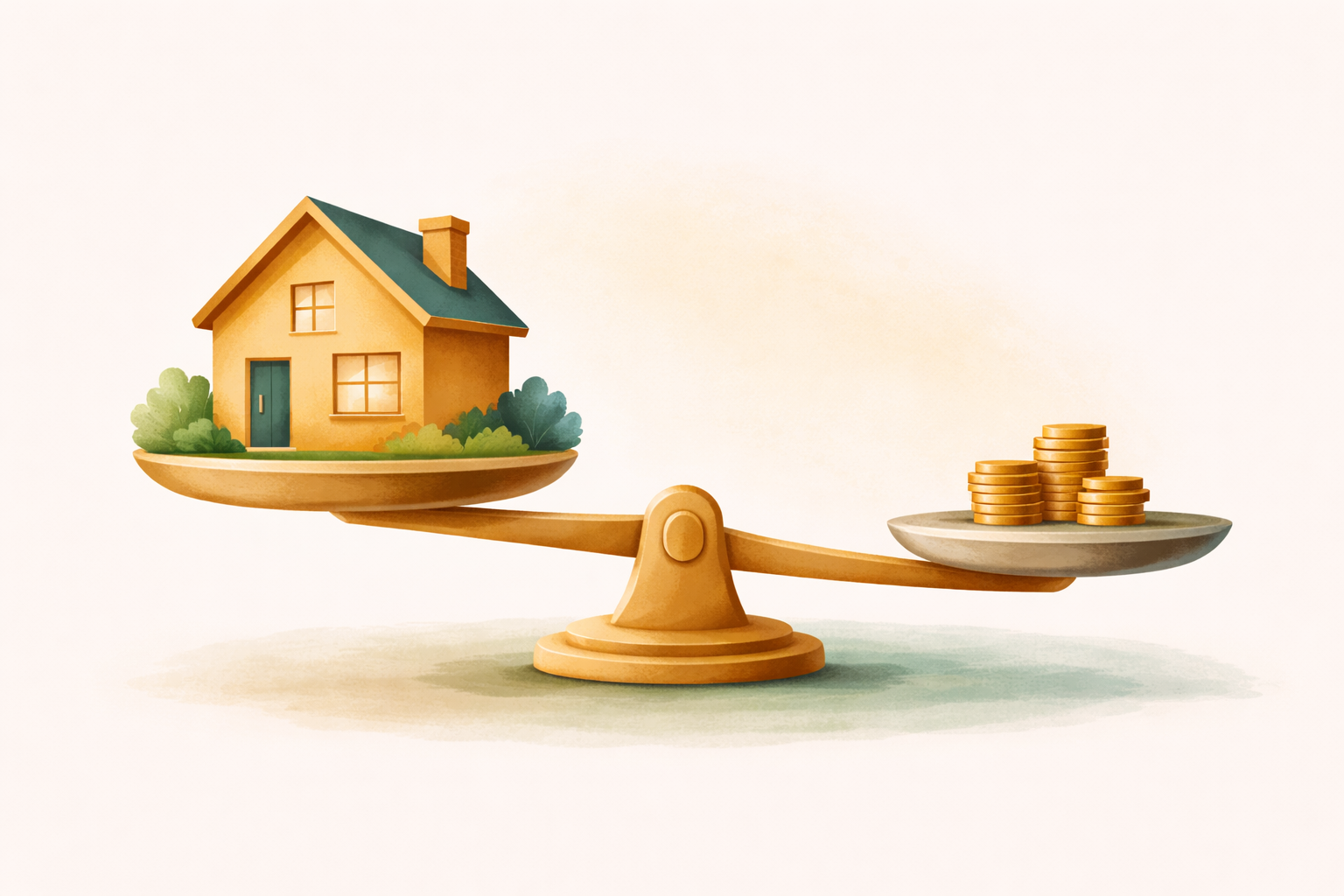
This section exists because honest financial writing requires it.
A reverse mortgage is not the right answer for every debt situation. Here are the cases where it probably isn't:
The debt is small and nearly paid off. If the remaining mortgage balance is $15,000 with two years left, taking out a reverse mortgage to clear it is almost certainly not worth the setup costs and the long-term interest implications. Finish paying it off.
The debt is manageable on the current income. If CPP, OAS, and other income sources cover the debt payments comfortably and there is money left over, there may be no structural problem to solve. A reverse mortgage should solve a problem. If there isn't one, don't create one.
The home has limited equity. A reverse mortgage requires meaningful equity to work. If the home is worth $450,000 and the existing mortgage balance is $380,000, the available equity after paying out the mortgage may not justify the structure.
A better tool exists for the situation. In some cases — particularly for homeowners under 55 — a term mortgage, a conventional refinance, or another product may be more appropriate. A broker who knows the full product landscape will tell you honestly which tool fits.
The reverse mortgage is powerful. It is not universal. Working with a licensed mortgage professional who specialises in retirement lending is how you know which category your situation falls into.
The Honest Summary
Debt in retirement is not a moral failure. It is a common financial situation that requires a practical solution.
For Canadian homeowners 55 and older who are carrying debt that their retirement income cannot comfortably service, the equity in their home is often the largest financial resource available — and a reverse mortgage is often the most practical way to deploy it.
It does not eliminate debt. It converts it. From mandatory to optional. From high-cost to lower-cost. From a structure that was built for an earning life to one that fits a retirement life.
That conversion is worth understanding. And for many people, it is worth doing.
[Get Your Free Comparison at Canada Reverse Mortgage Guide →]
This article is for educational purposes only and does not constitute financial, tax, investment, or mortgage advice. Interest rates, lender terms, and individual financial circumstances vary. A licensed Canadian mortgage broker can help you determine whether using home equity to address debt is appropriate for your specific situation. All reverse mortgage products are subject to individual lender approval and terms.