3 Reasons Canadians Over 55 Are Choosing to Age in Place — and How They're Funding It
The conventional retirement narrative used to go something like this: you retire, you sell the house, you downsize to something smaller and more manageable, you move somewhere warmer if you can afford it, and you spend the remaining years in a retirement community with organized activities and a dining room.
A growing number of Canadians are quietly rejecting this narrative.
Not because they haven't thought it through. Not because they are in denial about their futures. But because, when they actually look at the numbers and the evidence and their own preferences clearly, staying in the home they have lived in for decades turns out to be the better answer — financially, socially, and practically.
Here are the three reasons most often cited, and how home equity makes each of them possible.
Reason 1 — The Financial Case Is Stronger Than Most People Realise
Aging in place is widely assumed to be the emotional choice — the sentimental preference that sensible financial planning should override. The data does not support this assumption.
Consider what the alternative actually costs.
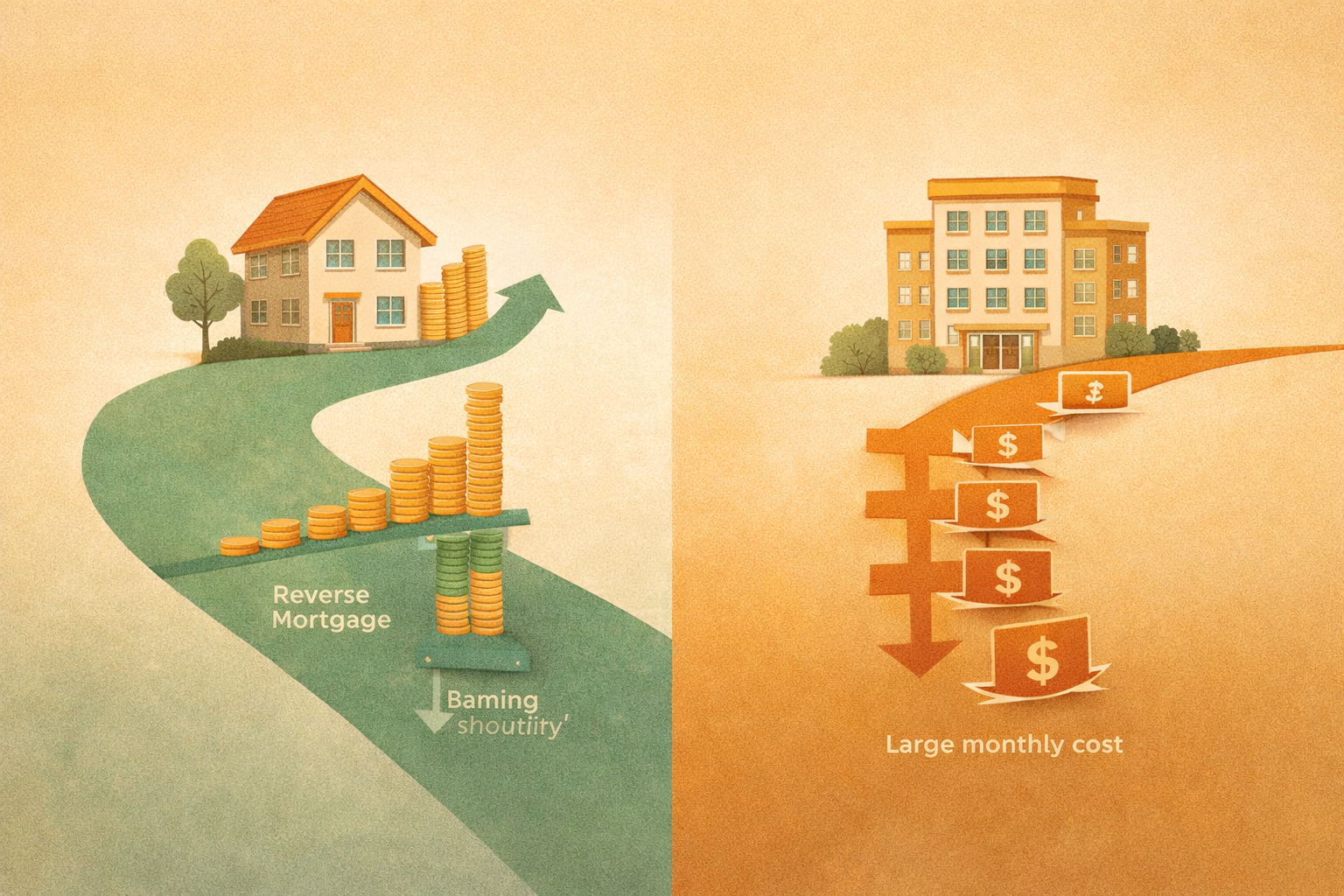
A retirement residence in Canada — an independent living community for seniors who do not yet need significant care — typically costs between $3,000 and $6,000 per month, all in. A retirement residence with assisted living or memory care support runs $5,000 to $10,000 per month or more, depending on the level of care and the city. In a major urban market, these numbers are consistently at the higher end.
At $4,000 per month, a retirement residence costs $48,000 per year. At $6,000 per month, it costs $72,000 per year. Over ten years, that is $480,000 to $720,000 — before any increases for inflation or care upgrades.
Against this, staying in a paid-off home costs property taxes, insurance, maintenance, and whatever care or support is needed at home. For many people — particularly those in reasonably good health who need modest support rather than intensive care — the total annual cost of staying home, including private care supplements, is significantly lower than the cost of a retirement residence.
And here is the part that changes the calculation further: the home continues to gain value while you live in it. A retirement residence does not. The money paid in monthly fees is gone. The equity in the home is not — it is available, potentially growing, and can be accessed when and if it is needed.
A reverse mortgage is how that equity becomes accessible without selling, without monthly payments, and without leaving. The interest builds on the drawn balance over time. But in many scenarios — particularly when the home is gaining value faster than the reverse mortgage balance is growing — the net financial outcome of aging in place with a reverse mortgage is better than the alternative.
This is not a sentimental argument. It is arithmetic.
Reason 2 — The Social and Psychological Evidence Is Compelling
Research on aging consistently finds that social connection, familiar environments, and a sense of continuity are among the strongest predictors of both cognitive health and overall wellbeing in older adults.
The home is not just a building. It is a network. The neighbours who have known you for twenty years. The coffee shop where the staff know your order. The church or community centre where you have been a face for decades. The routines — the morning walk, the garden in summer, the particular light in the kitchen on winter afternoons — that give the days their shape.
When a person moves to a retirement residence, they leave this network. They arrive somewhere new, at an age when building new relationships requires more effort and the existing ones are harder to maintain. Research suggests that involuntary or premature transitions to residential care settings are associated with accelerated cognitive decline and reduced life satisfaction — not because the care is poor, but because the loss of familiar environment and social network is itself a form of disruption that the aging brain and body absorb with difficulty.
None of this means retirement residences are bad. For people who need significant care, who are genuinely isolated where they live, or who want the social programming and convenience of a residential community, they are the right answer. But for people who have a home, a neighbourhood, and a social fabric they value — staying is not just sentimentality. It is an investment in the conditions that support health and wellbeing.
Home equity is what makes staying viable when income alone is not enough. A reverse mortgage can fund the modifications, the care supplements, and the monthly cash flow that allows a person to remain in the environment where they are most likely to thrive.

Reason 3 — The Practical Barriers Are More Solvable Than They Appear
The reason most people consider leaving their home is not because they want to. It is because one or more practical problems has made staying feel impossible.
The most common are:
Cash flow. Retirement income covers the basics but not the extras — the occasional larger expense, the home repair, the gap between what is needed and what government benefits provide. This is the most common reason people consider selling, and it is the problem a reverse mortgage is most directly designed to solve. A monthly draw, a lump sum reserve, or a combination can address a cash flow gap without forcing any change to the living arrangement.
Home maintenance. A large home that was easy to manage at 50 is more demanding at 70. Lawn care, snow removal, repairs, cleaning — the physical work of maintaining a property becomes harder as mobility and energy change. This is not an argument for leaving. It is an argument for spending money on the services that address it. Home equity can fund a lawn service, a cleaning service, and a handyman arrangement that keeps the property maintained without requiring the homeowner to do it themselves.
Safety and accessibility. Stairs, narrow bathrooms, high thresholds — the home as built may not be optimally suited to the person as they are now. Modifications address this, as discussed in Post 12. The key point here is that modifications are a one-time investment that extends the viability of staying in the home for years or decades. Home equity funds that investment without requiring liquid savings or monthly payments.
Isolation. For someone who has lost a spouse or whose mobility has reduced, isolation can become a genuine risk. This one is harder to solve with money alone — but transportation services, social programs, and in-home companionship care are all available and all have a cost. Home equity can fund access to the social infrastructure that keeps a person connected without requiring them to move to a community that provides it.
In each case, the barrier is real. And in each case, home equity is a resource that can address it — if it is deployed rather than left locked in the property indefinitely.
How the Funding Actually Works
For a homeowner 55 or older in Canada, a reverse mortgage is the primary tool for converting home equity into accessible, usable income without selling the home or making monthly payments.
The mechanics, briefly:
The lender approves a maximum loan amount based on age, property value, and location. The first draw has a minimum of $25,000. After that, the borrower can take a lump sum, a recurring monthly deposit, occasional draws as needed, or any combination. Interest builds on what has been drawn, not on the full approved limit.
For aging in place specifically, the monthly draw structure is often the most useful. A recurring $1,000 to $2,000 per month that supplements retirement income — covering care costs, maintenance services, modifications paid off over time, or simply the gap between income and a comfortable lifestyle — is a structural solution to the cash flow problem rather than a series of one-off fixes.
The approved amount does not need to be drawn all at once. Leaving a portion available for future needs — a health event, a larger repair, a period of increased care — is good planning. Interest builds only on what is drawn.
Use the calculator at the Canada Reverse Mortgage Guide to see what would be available for a specific age, property value, and location.
A Word on Planning
The homeowners who are most successfully aging in place are not the ones who are simply refusing to move. They are the ones who have made an active, considered decision to stay — and who have arranged the financial, physical, and social infrastructure to support that decision.
They have thought about the home modifications that will be needed in the next five to ten years. They have identified the services that will supplement their own capabilities as those change. They have a sense of what their home equity could provide and how they would access it if needed.
Aging in place is not passive. It is a plan. And like any plan, it works better when it has been thought through before it is urgently needed.
[Get Your Free Comparison at Canada Reverse Mortgage Guide →]
This article is for educational purposes only and does not constitute financial, tax, medical, or legal advice. Retirement residence and care costs vary significantly by province, city, and level of care. All cost figures are illustrative estimates only. Research references to cognitive health and aging in place are general in nature and individual circumstances vary. A licensed Canadian mortgage broker can help you understand what home equity may be available for your specific situation. All reverse mortgage products are subject to individual lender approval and terms.