
What Happens to Your Grandchildren's Education If You Don't Plan for It? How RESPs and Home Equity Work Together
There is a moment that happens in a lot of Canadian families.
A grandchild is born — or turns five, or ten — and the grandparents look at each other and think: we should be doing something for their education. Post-secondary costs in Canada are real and rising. Tuition, housing, books, living expenses — the total cost of a university or college education can easily reach $80,000 to $100,000 or more over four years, depending on the city and the program. That is not a number most young Canadians can carry alone.
Grandparents want to help. Often they genuinely can — not because they have surplus cash, but because they have something more substantial: significant equity in a paid-off home.
What most grandparents don't know is that there is a structured, government-supported savings vehicle specifically designed for this purpose — the Registered Education Savings Plan — and that home equity is one of the most tax-efficient ways to fund it.
This post explains how the two work together.
What an RESP Actually Is
A Registered Education Savings Plan is a tax-sheltered savings account designed specifically to fund post-secondary education for a named beneficiary. Contributions grow tax-free inside the account. When the beneficiary eventually withdraws the funds for education, the growth — but not the original contributions — is taxed in the student's hands, typically at a very low rate because students generally have little other income.
That tax structure is genuinely favourable. Money grows in a tax-free environment for potentially 18 years, then comes out taxed at the student's marginal rate — which is usually near zero.
But the most powerful feature of an RESP is not the tax treatment. It is the government grant.
The Canada Education Savings Grant — Free Government Money
The Canada Education Savings Grant (CESG) is a federal government matching program. For every dollar contributed to an RESP, the government adds 20 cents — up to $500 per year per beneficiary, based on a maximum eligible contribution of $2,500 annually.
Over 18 years, the maximum total CESG a beneficiary can receive is $7,200. That is $7,200 of government money added to the account simply for making contributions.
The CESG accumulates with unused room. If contributions were not made in early years, the room carries forward — and in a given year, a contributor can receive up to $1,000 in CESG (covering two years' worth of missed grant room at once) by contributing $5,000 in a single year.
For lower-income families, an additional Canada Learning Bond of up to $2,000 may also be available — though this is income-tested and does not apply in most grandparent scenarios.
The lifetime contribution limit per beneficiary is $50,000. The CESG is earned on the first $2,500 contributed per year (or up to $5,000 if catching up on a prior year's missed contribution).
Who Can Open and Contribute to an RESP
This is where it gets practical — and where most grandparents do not have accurate information.
Who can open an RESP: A parent or legal guardian typically opens the RESP as the subscriber. Grandparents can open an RESP for a grandchild, but if the parents already have an RESP open for that child, a second account is possible — though the total lifetime contribution limit of $50,000 applies across all accounts for that beneficiary.
Who can contribute: Anyone can contribute to an existing RESP. A grandparent does not need to be the account holder to make contributions. If the parents have already opened the account, the grandparent simply contributes to it.
Who receives the CESG: The CESG is paid into the account regardless of who makes the contribution, as long as the contribution is to an RESP where the beneficiary is eligible.
The practical takeaway: if the parents have already opened an RESP for the grandchild, the grandparent can contribute to it and trigger the CESG without opening a separate account. Coordinate with the parents first to understand how much room remains — both annually and against the $50,000 lifetime limit — before making any contribution.
Where Home Equity Fits
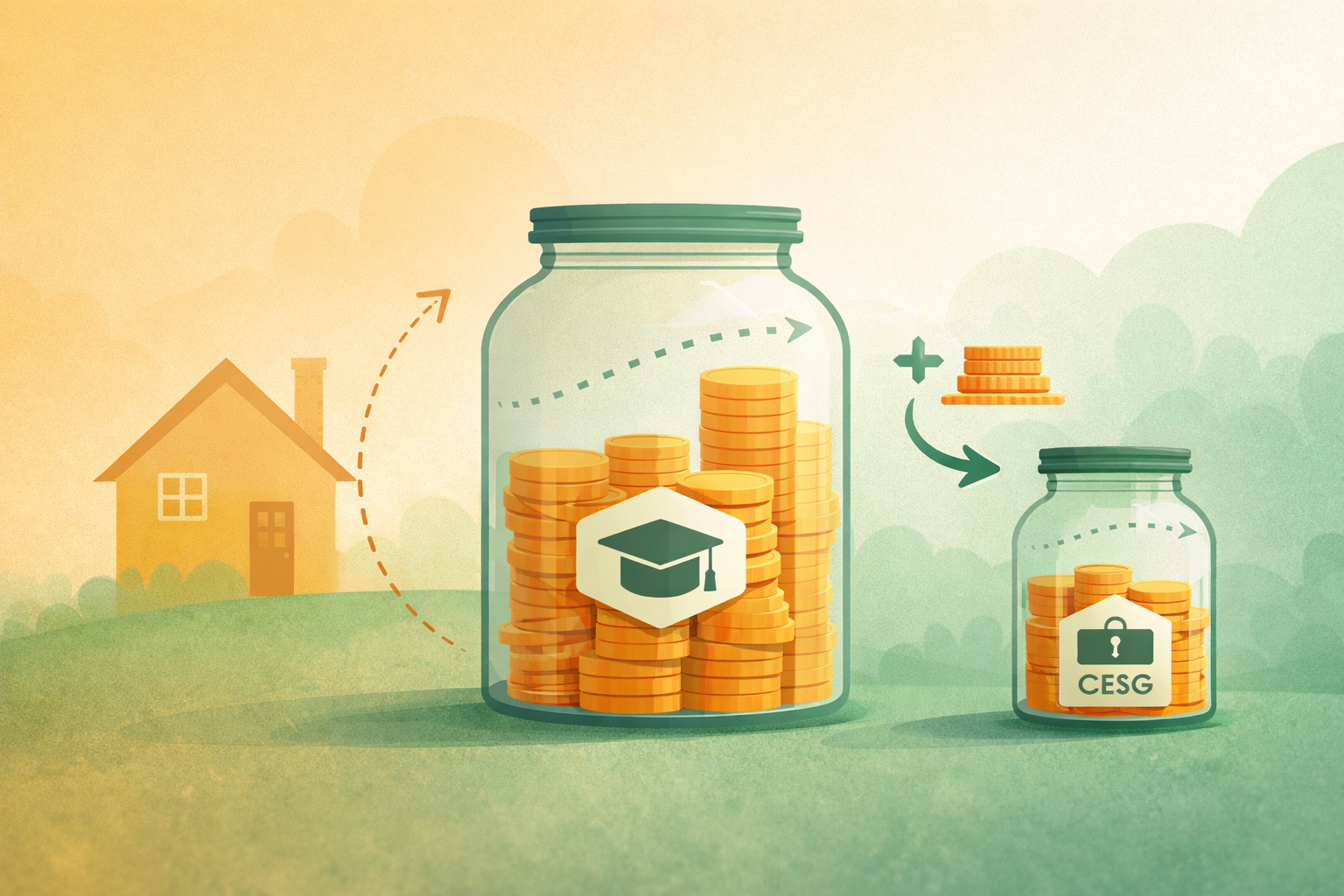
For a grandparent with significant home equity and modest liquid savings, a reverse mortgage is often the most practical way to fund RESP contributions without disrupting their retirement income plan.
Here is why this matters.
The alternatives to using home equity are drawing from registered accounts — an RRSP or RRIF — or from non-registered investments. Both have tax consequences. Every dollar withdrawn from a RRIF is fully taxable income. Large withdrawals can push net income above the OAS clawback threshold, reduce GIS entitlement, and trigger a higher marginal tax rate on every other dollar earned that year. Selling non-registered investments may trigger capital gains.
A reverse mortgage draw has none of these consequences. The proceeds are not income. They do not appear on a tax return. They do not affect OAS, GIS, or any other income-tested benefit. The contribution to the RESP is funded by the home — which is not generating investment income and is not part of the registered account structure — leaving the retirement income plan completely intact.
The combination is elegant: tax-free funds from a reverse mortgage flow into a tax-sheltered account, collect a 20% government grant on the first $2,500 per year, and grow tax-free for up to 18 years before coming out taxed at the student's typically very low rate.
What the Numbers Look Like
Let's put some rough numbers to it.
A grandparent decides to contribute $2,500 per year to a grandchild's RESP starting at birth. They fund these contributions from a reverse mortgage draw — $2,500 per year, or about $208 per month.
Each year, the government adds $500 in CESG. Over 18 years, that is $9,000 in government contributions alone, assuming the grant is collected every year from birth.
The $2,500 annual contribution over 18 years totals $45,000 from the grandparent. With the $9,000 in CESG added, the account starts with $54,000 in total contributions before any investment growth. With modest investment returns inside the account, the total available for the grandchild's education could be significantly higher.
The reverse mortgage balance grows over those 18 years by the cost of the draws plus accumulated interest. But the grandparent has made no payments, their retirement income is unchanged, and their home has continued to gain value throughout.
Whether the math favours this approach depends on the specific situation — the grandparent's age, the home's value, the applicable reverse mortgage rate, and the expected investment returns inside the RESP. A financial advisor can model it. The point here is that it is modelable and in many situations it works very well.

A Lump Sum Versus Annual Contributions
One decision worth thinking through: should the grandparent make one large contribution or contribute annually?
Annual contributions maximise the CESG. The grant is calculated on annual contributions, and there is a cap on how much catch-up can happen in any given year. Contributing $2,500 per year from birth collects the full $500 grant each year. This is generally the most efficient approach for capturing the maximum total CESG.
Lump sum contributions can be useful for older grandchildren where the remaining contribution window is short. Contributing a larger amount to a 12-year-old's RESP — catching up on missed years at $5,000 per year to collect double the annual CESG — can still accumulate meaningful grant money and tax-free growth before post-secondary education begins.
Lifetime limit awareness is critical regardless of approach. The $50,000 lifetime limit applies across all RESPs for a given beneficiary. If the parents have been contributing steadily, the remaining room may be less than the grandparent assumes. Confirm the available room before making any contribution.
What Happens If the Grandchild Doesn't Go to Post-Secondary
This is the question every grandparent eventually asks.
If the beneficiary does not pursue eligible post-secondary education, the CESG must be repaid to the government. The original contributions can be returned to the subscriber (the account holder) tax-free — since they were made with after-tax dollars. The investment growth inside the account can be withdrawn, but it is taxed as income in the subscriber's hands, and an additional 20% penalty tax applies to the growth portion.
This is a real risk. It is worth knowing clearly before opening or contributing to an account.
The mitigation: RESPs can be transferred to a sibling beneficiary. If one grandchild does not pursue post-secondary education, the account can be redirected to another eligible grandchild. Family plan RESPs — which allow multiple beneficiaries — are specifically designed for this.
A financial advisor can structure the account to minimise this risk for the specific family situation.
The Plain-English Summary
A grandparent with home equity can fund a grandchild's RESP — collecting the 20% government grant on up to $2,500 per year — without drawing from registered accounts, without triggering taxable income, and without making payments on the reverse mortgage.
The funds grow tax-free in the RESP and come out taxed at the student's low rate when used for education. The home continues to gain value. The grandparent's retirement income plan is undisturbed.
For grandparents who want to do something meaningful for the next generation's education — and who have the equity to make it possible — this is a strategy worth having a proper conversation about.
[Get Your Free Comparison at Canada Reverse Mortgage Guide →]
This article is for educational purposes only and does not constitute financial, tax, investment, or legal advice. RESP rules, CESG eligibility, contribution limits, and tax treatment are subject to change and vary by individual circumstance. The Canada Learning Bond eligibility is income-tested. All figures are illustrative only. Consult a qualified financial advisor before making RESP contributions or structuring an education savings strategy. All reverse mortgage products are subject to individual lender approval and terms.