
Why Most Financial Advisors Get Reverse Mortgages Wrong — and What a Good One Does Instead
This post is written for two audiences simultaneously.
For financial advisors: this is an honest examination of the most common mistakes made when advising clients on reverse mortgages — and a framework for doing it better. It is not a criticism of the profession. It is an acknowledgment that most financial planning training in Canada does not cover reverse mortgages adequately, and that the gap between what advisors typically recommend and what the evidence supports is real and worth addressing.
For clients of financial advisors: this is a framework for evaluating whether the guidance you are receiving on this topic reflects the current state of the evidence — or a default position that has not been rigorously examined.
The Default Position and Why It Exists
Most Canadian financial advisors, when a client raises a reverse mortgage, default to one of two responses.
The first is a simple recommendation against it: "I wouldn't recommend that — the rates are high and you'll eat into your estate." The second is a deflection: "That's really a mortgage question. You'd want to talk to a mortgage broker about that."
Neither response is serving the client well. Both reflect a gap in knowledge rather than a considered position.
The gap exists for understandable reasons. Financial planning curricula in Canada — the CFP program, the PFP designation, most continuing education — cover registered accounts, tax planning, estate planning, and investment management in significant depth. They cover mortgage products superficially, if at all. The reverse mortgage, as a product that sits at the intersection of mortgage lending and retirement income planning, falls into a gap that neither the financial planning world nor the mortgage world has traditionally claimed.
The result: advisors who are genuinely expert in RRSP drawdown sequencing, OAS clawback management, and estate planning have no real framework for incorporating home equity — specifically reverse mortgage proceeds — into the retirement income plans they build. So they default to either dismissal or deflection.
The Three Mistakes Most Advisors Make
Mistake 1 — Treating the Home as Off the Balance Sheet
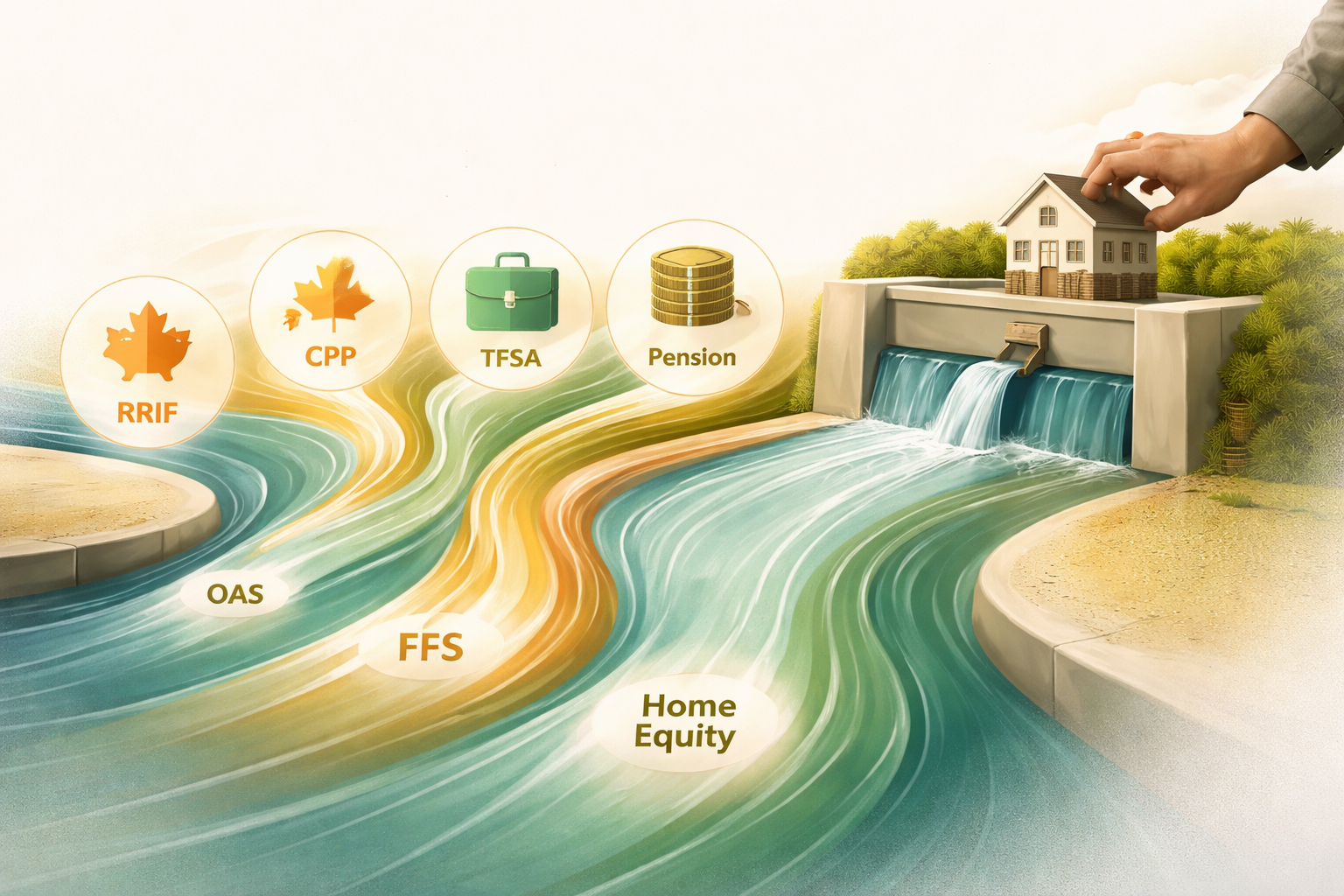
Every financial advisor knows to ask about assets and liabilities. They model the RRSP, the TFSA, the non-registered portfolio, the pension. They project the RRIF drawdown schedule, the CPP and OAS timing, the tax liability across different income scenarios.
The home is listed as an asset. And then it is essentially ignored.
It appears on the net worth statement. It does not appear in the income plan. It is treated as a non-liquid asset that is available only through sale — which is not a realistic option for most clients who want to stay in their home — or as an emergency backstop that will be there if everything else runs out.
This is incomplete analysis. The home equity is real, it is often the largest asset on the balance sheet, and it can be made liquid — without sale, without payment, with tax-free proceeds — through a reverse mortgage. A retirement income plan that does not model the home equity option is missing a significant variable.
The advisor who asks "what would the plan look like if we incorporated a reverse mortgage draw of $X per month to supplement income and reduce RRIF withdrawals" is doing better analysis than the advisor who does not ask the question.
Mistake 2 — Evaluating the Reverse Mortgage in Isolation
The most common framing when advisors do engage with reverse mortgages is: "Is the interest rate on the reverse mortgage higher or lower than the expected return on the assets being preserved?"
This is a reasonable question. It is also incomplete.
A reverse mortgage is not evaluated in isolation. It is evaluated as part of a system. The relevant comparison is not "reverse mortgage rate versus investment return" — it is "reverse mortgage draw versus the tax and income implications of the alternative."
The alternative to a reverse mortgage draw is almost always a RRIF withdrawal, a registered account draw, or a non-registered investment liquidation. Every one of those alternatives has tax consequences: taxable income, potential OAS clawback, potential GIS reduction, capital gains, bracket effects.
A reverse mortgage draw has none of these consequences. It is not income. It does not appear on the tax return. It does not affect OAS, GIS, or any income-tested benefit.
The correct comparison is not "reverse mortgage rate versus investment return." It is "reverse mortgage interest cost versus the combined cost of the alternative — including tax, benefit loss, and the depletion of assets that were generating income."
In many scenarios — particularly for clients near the OAS clawback threshold, for GIS-eligible clients with home equity, or for clients with RRIF balances that will force large taxable distributions in later years — the after-tax case for a reverse mortgage draw is substantially stronger than the pre-tax rate comparison suggests.
Mistake 3 — Overlooking the Structural Advantages
Beyond the tax efficiency, there are structural advantages to reverse mortgage proceeds that the isolation framing misses entirely.
Reverse mortgage proceeds are non-callable. An investment portfolio can decline. A HELOC can be frozen or reduced. A pension income stream can be affected by the health of the plan. Reverse mortgage proceeds, once drawn, are not subject to any of these risks.
The approved limit is non-callable as well. As long as the borrower maintains the property, pays taxes and insurance, and lives in the home, the lender cannot reduce the approved limit or demand repayment.
For a client building a retirement income plan, this structural stability has value that does not appear in a simple rate comparison. It is a guaranteed, non-callable source of supplemental income that diversifies the income portfolio in a meaningful way.
What a Good Advisor Does Instead
A financial advisor who approaches reverse mortgages well does the following:
Models home equity explicitly in the retirement income plan. Rather than treating the home as an off-balance-sheet reserve, they include it as a variable in the income projections. What does the plan look like with a reverse mortgage draw of $1,000 per month? $2,000? A one-time lump sum? How does each scenario affect the RRIF drawdown schedule, the tax liability, the OAS clawback risk, and the estate outcome?
Compares the after-tax cost, not the pre-tax rate. They run the numbers on what a $24,000 per year reverse mortgage draw actually costs in interest — and what the alternative (a $24,000 RRIF withdrawal) costs in tax, benefit loss, and mandatory minimum escalation.
Refers to a specialist broker for the mortgage side. A financial advisor is not expected to be a reverse mortgage expert. They are expected to know enough to ask the right questions and to refer to someone who can answer them. A broker who works with all four Canadian reverse mortgage lenders and who can produce a side-by-side comparison is the right referral. This is not giving up control of the client relationship — it is serving the client well by bringing in the right expertise at the right moment.
Has the conversation proactively. Rather than waiting for the client to raise a reverse mortgage — and then responding with a default dismissal — the advisor who understands the landscape raises it themselves when the client profile fits. "Given the equity in your home and the structure of your registered accounts, I think it's worth understanding what a reverse mortgage could add to the plan. Have you thought about that?"
Maintains the relationship. A financial advisor who brings a mortgage broker into the planning process does not lose the client. They deepen the relationship by demonstrating that they are genuinely seeking the best outcome rather than limiting the conversation to their own area of expertise.
A Note on the Broker-Advisor Relationship
The best outcomes for clients come when the mortgage broker and the financial advisor are working from the same information.
This is not common in Canada. Most reverse mortgage transactions happen with no financial advisor involved. Most financial planning conversations happen with no mortgage professional involved. The two worlds run parallel and rarely intersect — to the detriment of the clients who sit in the middle.
The broker who brings a financial advisor into the reverse mortgage conversation — and the advisor who refers to a reverse mortgage specialist rather than dismissing the question — are both serving their clients better than the industry norm.
Matthew Hines works alongside financial advisors and their clients. He is not a competitor to the advisor relationship — he is a specialist who can answer the mortgage side of the question that the advisor cannot fully answer on their own.
If you are a financial advisor with a client for whom a reverse mortgage may be relevant, that conversation is available.
[Start the Conversation at Canada Reverse Mortgage Guide →]
This article is for educational purposes only and does not constitute financial, tax, investment, or mortgage advice. The views expressed are those of the author and are intended as a professional discussion of retirement income planning approaches. All reverse mortgage products are subject to individual lender approval and terms.